8 Open-Source Platforms to Add Observability to Your LLM Applications (No Vendor Lock-In)

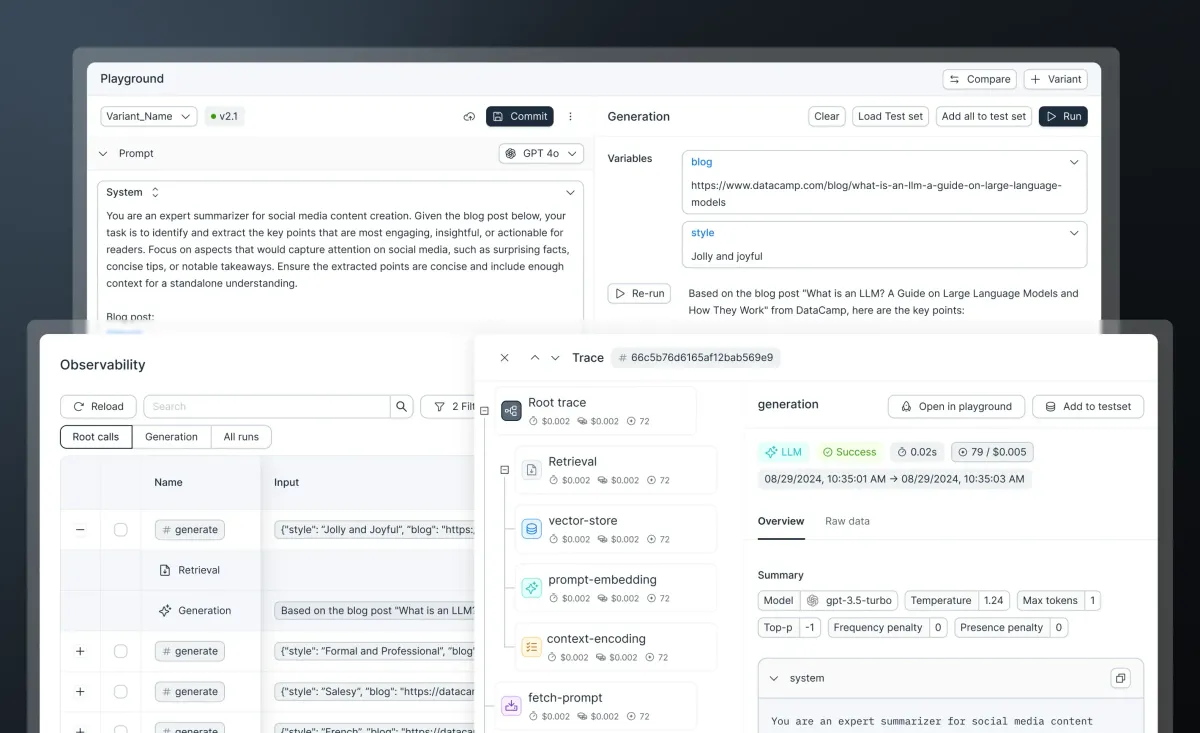
As Large Language Models (LLMs) power everything from customer support chatbots to internal coding assistants, reliability, transparency, and performance have become non-negotiable. But unlike traditional software, LLMs are inherently probabilistic—making them prone to hallucinations, latency spikes, and unexpected behavior.
That’s where LLM observability comes in.
And if you care about data privacy, cost control, or avoiding vendor lock-in, you’ll want open-source, self-hostable observability platforms, tools you can deploy on your own infrastructure and fully own.
In this guide, we’ll break down what LLM observability really means, why self-hosting matters, and, most importantly, the top open-source platforms you can deploy today to gain full visibility into your LLM-powered apps.
What Is LLM Observability?
LLM observability refers to the ability to monitor, trace, evaluate, and debug how your language models behave in real-world use. Unlike simple logging, true observability gives you:
- Full context of every user interaction (prompt → response → metadata)
- Performance metrics like latency, token usage, and error rates
- Quality signals: hallucination detection, bias scoring, relevance
- Drift alerts when input patterns or output quality shift over time
- Feedback loops to continuously improve your system
Self-hosting these tools ensures:
- Your sensitive prompts and responses never leave your network
- No per-request pricing or usage caps
- Full customization for compliance (GDPR, HIPAA, etc.)
- Integration with your existing DevOps and MLOps stack
In this guide, we break down the top open-source platforms you can deploy today, including Langfuse, Helicone, Agenta, MLflow, Pezzo, Phoenix, OpenLLMetry, and the OSS LLMOps Stack, each offering powerful features like trace-based debugging, prompt versioning, automated evaluations, cost tracking, and real-time playgrounds.
For developers, this means faster iteration, safer deployments, lower costs, and full ownership of your AI telemetry. Whether you're building a customer-facing chatbot or an internal coding assistant, these tools turn black-box LLMs into transparent, reliable, and measurable systems, right from your own infrastructure.
Now, let’s dive into the best open-source, self-hostable LLM observability platforms available right now.
1- Langfuse
Langfuse is an open-source LLM engineering platform built for teams serious about shipping reliable AI apps. As a Y Combinator W23 alum, it delivers observability, prompt management, evaluations, and more, all while integrating seamlessly with OpenTelemetry, LangChain, OpenAI SDK, LiteLLM, and beyond.
Track every LLM call, retrieval step, or agent action with rich, debuggable traces. Explore user sessions, inspect complex logs, and monitor performance in real time, self-hosted in minutes and ready for production. Plus, its blazing-fast caching ensures prompt iterations never slow you down.
From LLM-as-a-judge to user feedback and custom eval pipelines, Langfuse makes evaluation effortless. Collaborate on prompts with version control, test rigorously, and ship confidently. It’s the all-in-one toolkit for building, debugging, and scaling AI applications, open, flexible, and battle-tested.
Langfuse Features
- LLM Observability: Trace and debug every LLM call, retrieval, embedding, and agent step with full context and session replay.
- Prompt Management: Centrally store, version, and collaborate on prompts—with smart caching to avoid latency.
- Evaluations: Run automated (LLM-as-a-judge), human-in-the-loop (user feedback, manual labels), or custom evals via APIs.
- Datasets: Create test sets and benchmarks for pre-deployment validation, experiments, and continuous improvement.
- LLM Playground: Rapidly prototype and refine prompts and model settings—jump straight from traces to testing.
- Developer-Friendly API: Build custom LLMOps workflows with typed SDKs (Python, JS/TS), OpenAPI spec, and Postman support.
- Integrates with dozens of AI tools and LLMs apps
 langfuse
2- Helicone
Helicone is an open-source LLM observability platform (YC W23) that adds monitoring, evaluation, and experimentation with just one line of code—supporting OpenAI, Anthropic, LangChain, and more. Debug traces, track cost/latency, and iterate fast in the built-in playground.
Helicone's Features
- One-line integration with OpenAI, Anthropic, LangChain, Gemini, LlamaIndex, LiteLLM, and more
- Full observability: trace and debug agents, chatbots, and RAG pipelines
- Real-time analytics: monitor cost, latency, quality, and export to PostHog instantly
- Built-in playground, test and refine prompts, sessions, and traces visually
- Prompt management: version, experiment, and control prompts using live data
- Automated evaluations: run evals via LastMile, Ragas, and more on every trace
- Fine-tuning workflows: seamless integration with OpenPipe, Autonomi, and partners
- Smart gateway: add caching, rate limiting, and LLM security in minutes
- Enterprise-ready: SOC 2 and GDPR compliant, self-hostable, open-source
 Helicone
3- Agenta

Agenta is an open-source LLMOps platform built to streamline the creation of production-ready LLM applications. By tightly integrating prompt management, evaluation, and observability into one intuitive interface, Agenta empowers engineering and product teams to ship high-quality AI features with speed and confidence.
Its also a collaborative prompt playground lets developers and subject matter experts rapidly prototype, test, and compare prompts side by side using real-world test cases—enabling fast iteration while safeguarding live systems from regressions.
Unlike generic tooling, Agenta embeds LLMOps best practices directly into the development workflow. From initial experimentation to continuous monitoring in production, it ensures your LLM applications remain reliable, transparent, and performant, making it the go-to open-source choice for teams serious about shipping AI at scale.
 Agenta-AI
4- MLflow
MLflow is an open-source platform that helps developers build and ship reliable AI and LLM applications with confidence. It brings together experiment tracking, prompt management, LLM evaluation, and observability in one unified system.
Whether you're fine-tuning prompts, debugging agentic workflows, or comparing model versions, MLflow keeps everything, from code to outputs, organized and traceable. Trusted by teams worldwide, it’s built for both traditional ML and modern generative AI, making production AI development smoother, faster, and more transparent.
MLflow Features
- End-to-End Experiment Tracking: Log and compare models, parameters, metrics, and artifacts with an intuitive UI
- LLM Observability & Tracing: Debug agentic workflows and trace LLM calls, tools, and internal states in real time
- Prompt Management: Version, share, and reuse prompts across teams with full lineage and reproducibility
- Automated LLM Evaluation: Run and compare evaluations across prompt and model versions—integrated with experiment tracking
- Model Registry: Centralized hub to stage, annotate, and manage model lifecycle from dev to production
- Flexible Deployment: Deploy models to Docker, Kubernetes, AWS SageMaker, Azure ML, and more for batch or real-time inference
- Full App Versioning: Track code, models, prompts, tools, and dependencies together with end-to-end lineage
- Self-Hosted & Open Source: Run MLflow on your infrastructure—no vendor lock-in, full control over your data
- Developer-Friendly SDKs: Python-first with REST APIs, CLI, and seamless integration into existing ML/LLM workflows
 mlflow
5- Pezzo
Pezzo is a friendly, open-source LLMOps platform built for developers who want to move fast without the headaches. It brings everything you need, prompt design, versioning, real-time observability, and team collaboration, into one smooth, cloud-native experience. Spot issues quickly, cut latency and costs by up to 90%, and ship AI updates instantly, safely, and together with your team.
Think of Pezzo as your co-pilot for building reliable, responsive, and cost-efficient LLM apps!
 pezzolabs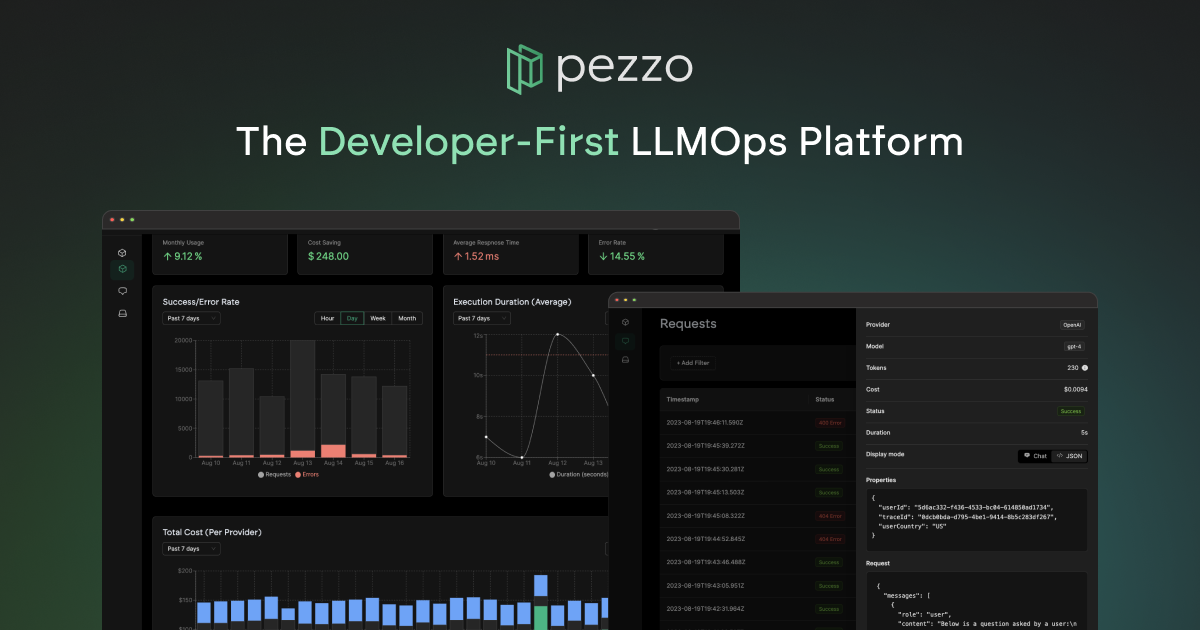
6- Phoenix
Phoenix is your friendly, open-source AI observability sidekick—built for experimenting, evaluating, and debugging LLM apps with ease. Trace runs, compare prompts, test models, and manage datasets all in one place.
It works with your favorite tools like LangChain, LlamaIndex, and any LLM provider, and it’s totally vendor- and language-agnostic. Plus, thanks to OpenInference, setup is a breeze!
Phoenix Features
- OpenTelemetry-Based Tracing: Automatically trace LLM app execution—including prompts, retrievals, and tool calls—for deep visibility and debugging.
- Built-in LLM Evaluations: Run response and retrieval evaluations using LLM-as-a-judge to benchmark performance over time.
- Versioned Datasets: Create, manage, and reuse labeled example sets for testing, evaluation, and fine-tuning.
- Experiment Tracking: Compare the impact of changes to prompts, models, or retrieval logic in structured experiments.
- Interactive Playground: Replay real traces, tweak prompts, switch models, and adjust parameters to optimize performance instantly.
- Prompt Management: Version, tag, and test prompts systematically—ensuring safe, collaborative iteration.
- Framework & Provider Agnostic: Works out of the box with LangChain, LlamaIndex, Haystack, DSPy, smolagents, and LLMs like OpenAI, Bedrock, MistralAI, VertexAI, LiteLLM, Google GenAI, and more.
- Powered by OpenInference: Auto-instrument your apps with minimal code using the open standard for LLM observability.
 Arize-ai
7- LLMOps stack
This is a free and open-source Modular, open source LLMOps stack that separates concerns: LiteLLM unifies LLM APIs, manages routing and cost controls, and ensures high-availability, while Langfuse focuses on detailed observability, prompt versioning, and performance evaluations.
 langfuse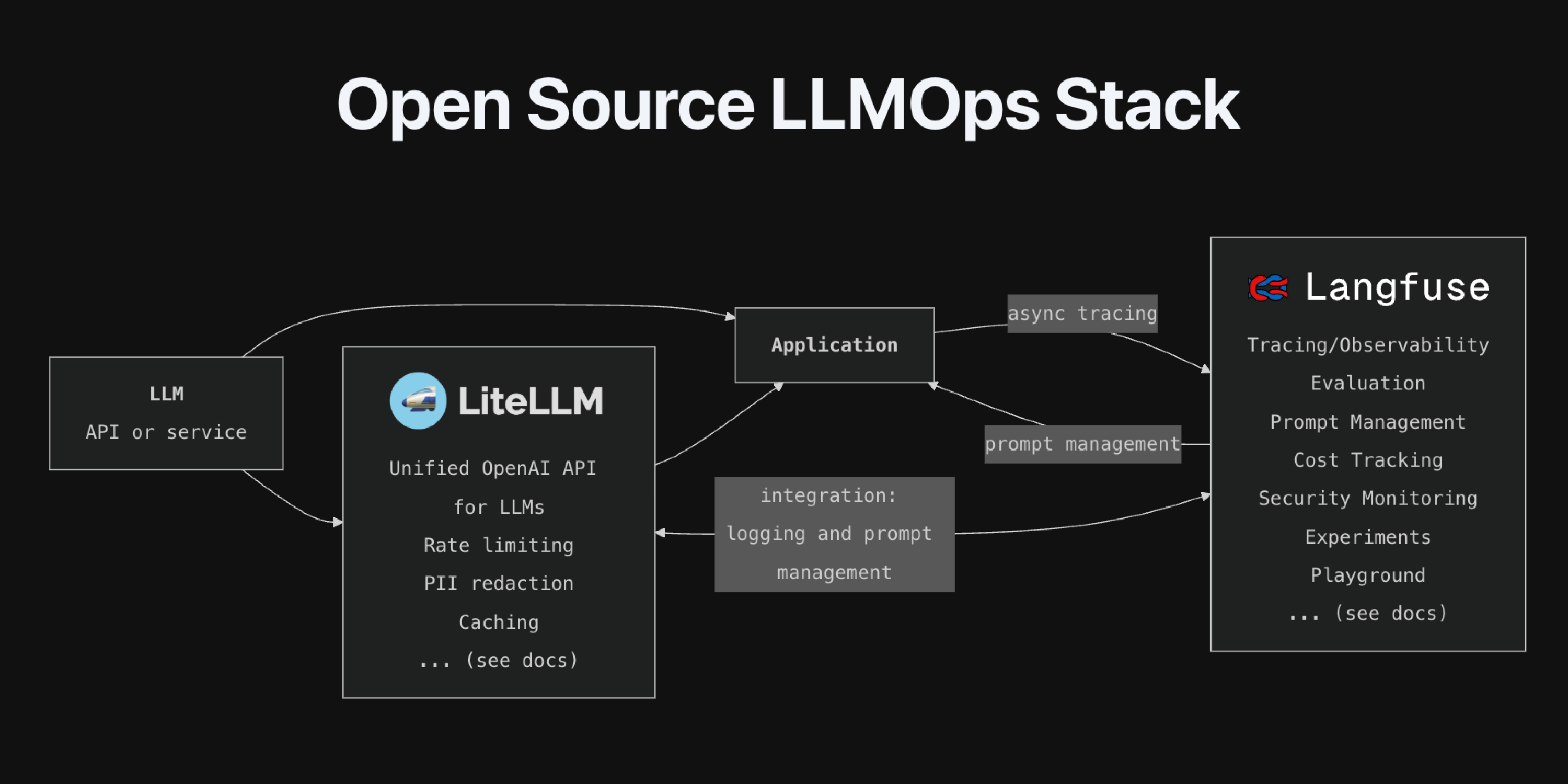
8- OpenLLMetry
OpenLLMetry is an open-source, OpenTelemetry-native observability solution for LLM applications, built by Traceloop. It extends OpenTelemetry with custom instrumentations for over 20 LLM providers, including OpenAI, Anthropic, Mistral, Bedrock, Vertex AI, and Groq, and major vector databases like Pinecone, Weaviate, Chroma, and Qdrant.
It also supports popular AI frameworks such as LangChain, LlamaIndex, Haystack, CrewAI, and LiteLLM.
Because it outputs standard OpenTelemetry data, OpenLLMetry seamlessly integrates with 20+ backends like Datadog, Honeycomb, Grafana, New Relic, Splunk, Google Cloud, Azure Application Insights, and more.
Whether you're monitoring LLM calls, retrieval steps, or full agentic workflows, OpenLLMetry plugs into your existing observability stack with zero vendor lock-in. Fully open-source (Apache 2.0) and community-driven, it’s designed for developers who want deep, standardized visibility into their AI systems, without rewriting their telemetry pipeline.
 traceloop