
CudaText is an open-source code editor with minimal requirement
Cross-platform text editor, written in Lazarus

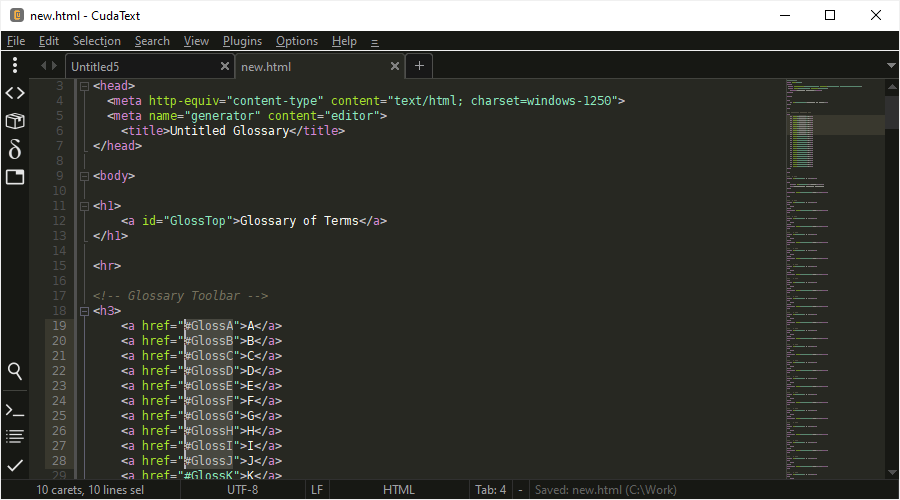
CudaText is a cross-platform text editor, written in Object Pascal. It is open source project and can be used free of charge, even for business. It starts quite fast: ~0.3 sec with ~30 plugins, on Linux on CPU Intel Core i3 3GHz.
CudaText is built using Lazarus IDE the Delphi compatible cross-platform IDE for RAD (Rapid Application Development).
Features
- Fast startup time
- Syntax highlight for a lot of languages (270+ lexers).
- Plugins: Extensible by Python
- Code tree: structure of functions/classes/etc, if lexer allows it.
- Code folding.
- Multi-carets and multi-selections.
- Find/Replace with regular expressions.
- Configs in JSON format. Including lexer-specific configs.
- Tabbed UI.
- Split view to primary/secondary. Split window to 2/3/4/6 groups of tabs.
- Command palette, with fuzzy matching.
- Minimap. Micromap.
- Show unprinted whitespace.
- Support for many encodings.
- Customizable hotkeys.
- Binary/Hex viewer for files of unlimited size (can show 10 Gb logs).
- Correctly saves binary files.
- Comments manager
- Tabbed user-interface
- Advanced search options
Web Development features (HTML/ CSS)
- Smart auto-completion for HTML, CSS.
- Image viewer
- HTML tags completion with Tab-key (Snippets plugin).
- HTML color codes (#rgb, #rrggbb) underline.
- Show pictures inside editor area (jpeg/png/gif/bmp/ico).
- Show tooltip when mouse moves over picture tag, entity, color value.
Features extended as plugins
- Add-ons manager
- Find in files
- Snippets
- LSP protocol support
- External tools
- Project manager
- Session manager
- Macro manager
- Spell checker
- FTP panel
- Highlight all occurrences
- Color picker
- Insert date/time
- Linters support (CudaLint)
- Formatters for HTML/CSS/JS/XML/... (CudaFormatter)
- Creating backup files
- Menu configurator
- and more...
License
CudaText is written and released under the MPL-2.0 (Mozilla Public License 2.0) License.