Instant is like giving your app superpowers

I’ve seen a lot of tools promise to make frontend development easier, but few actually deliver. Most times, you end up with more boilerplate than features, more infrastructure than interface. But what if the database wasn't something you had to build around… but something you built with?
That’s what Instant does. It hands you a real-time, multiplayer, offline-ready database right in your frontend, so you can focus on what actually matters, the UX.
What is Instant?
Instant provides a real-time database directly in your frontend. Instead of writing API endpoints and managing Redux/stores, you simply write relational queries inside your component (similar to GraphQL), and Instant handles the rest.
Features
- Relational Queries: You request data in the shape you want (using a language called InstaQL), and it handles the fetching.
- Multiplayer by Default: Every query creates a live connection. If one user updates data, everyone else sees it instantly.
- Offline-First: It handles offline caching automatically. It saves data to
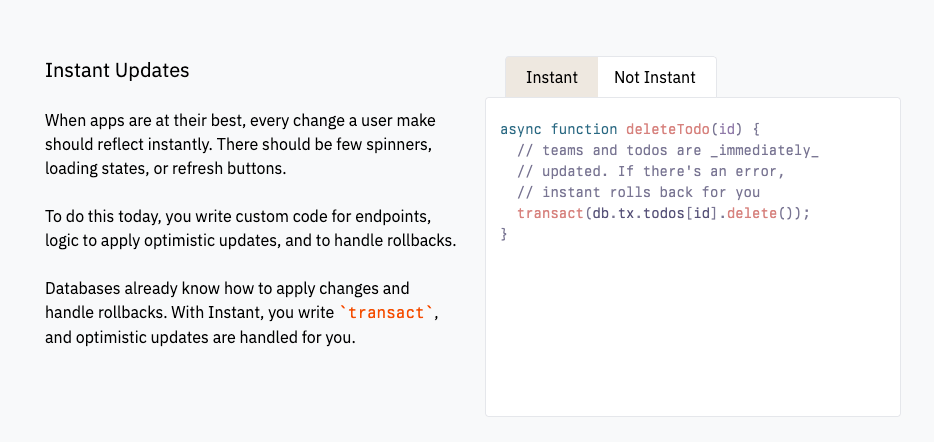
IndexedDB(Web) orAsyncStorage(React Native) so apps work without an internet connection. - Optimistic Updates: The UI updates immediately when a user performs an action, and Instant handles the rollbacks if the server rejects it.
- Ephemeral State: It supports temporary data like "who is online" or mouse cursors, which are essential for collaboration tools.
How does Instant Work?
- Backend: It uses a massive Postgres database to store data as "triples" (Subject-Attribute-Value).
- Sync Engine: A server written in Clojure watches the Postgres database (tailing the WAL) to detect changes and push updates to clients immediately.
- Permissions: It uses Google's CEL library to handle security and data access rules.
Here's how it hit me: building a real-time chat used to be a chore. Setting up WebSockets, handling reconnections, caching offline messages, writing optimistic updates, it's a whole stack just for a chat box. With Instant, it’s 12 lines. Seriously.
You just write a query in the shape of the data you want:
const { data } = db.useQuery({
  messages: {},
});
You update data with a simple transaction:
db.transact(db.tx.messages[id()].update({ text: "Hey there!" }));
That’s it.
Instant handles the rest: permissions, real-time sync, caching, rollbacks, everything that usually turns a simple feature into a multi-day project.
They call these “schleps”, the invisible work that slows us down. Instant compresses them. A lot. If you’ve ever felt like you’re spending more time wiring up state than crafting experiences, this feels like the missing layer.
Want to see it live? They have a browser demo you can play with right now, no signup, no install. Just open and tinker.
I’m excited about tools that let us build faster by getting out of the way. Instant feels like one of them.
If you're curious, check it out and see what you think. Might just change how you build your next feature.
Resources & Downloads

 instantdb