
Top 5 Leading Healthcare Product Engineering Firms Driving Digital Innovation
This article explores the leading product engineering firms that are shaping the future of digital health, with particular attention to companies pioneering hardware-software integration and IoT-enabled healthcare solutions.

The healthcare product engineering sector is undergoing a remarkable transformation in 2025-2026. Companies are shifting from experimental solutions to integrated, scalable platforms that address real-world healthcare challenges. With the digital health market surpassing $81 billion in 2023 and continuing its double-digit growth trajectory, the demand for specialized engineering firms has never been higher. Regulatory clarity, artificial intelligence maturation, and mounting workforce pressures are driving unprecedented innovation across the industry.
This article explores the leading product engineering firms that are shaping the future of digital health, with particular attention to companies pioneering hardware-software integration and IoT-enabled healthcare solutions.
1. Yalantis
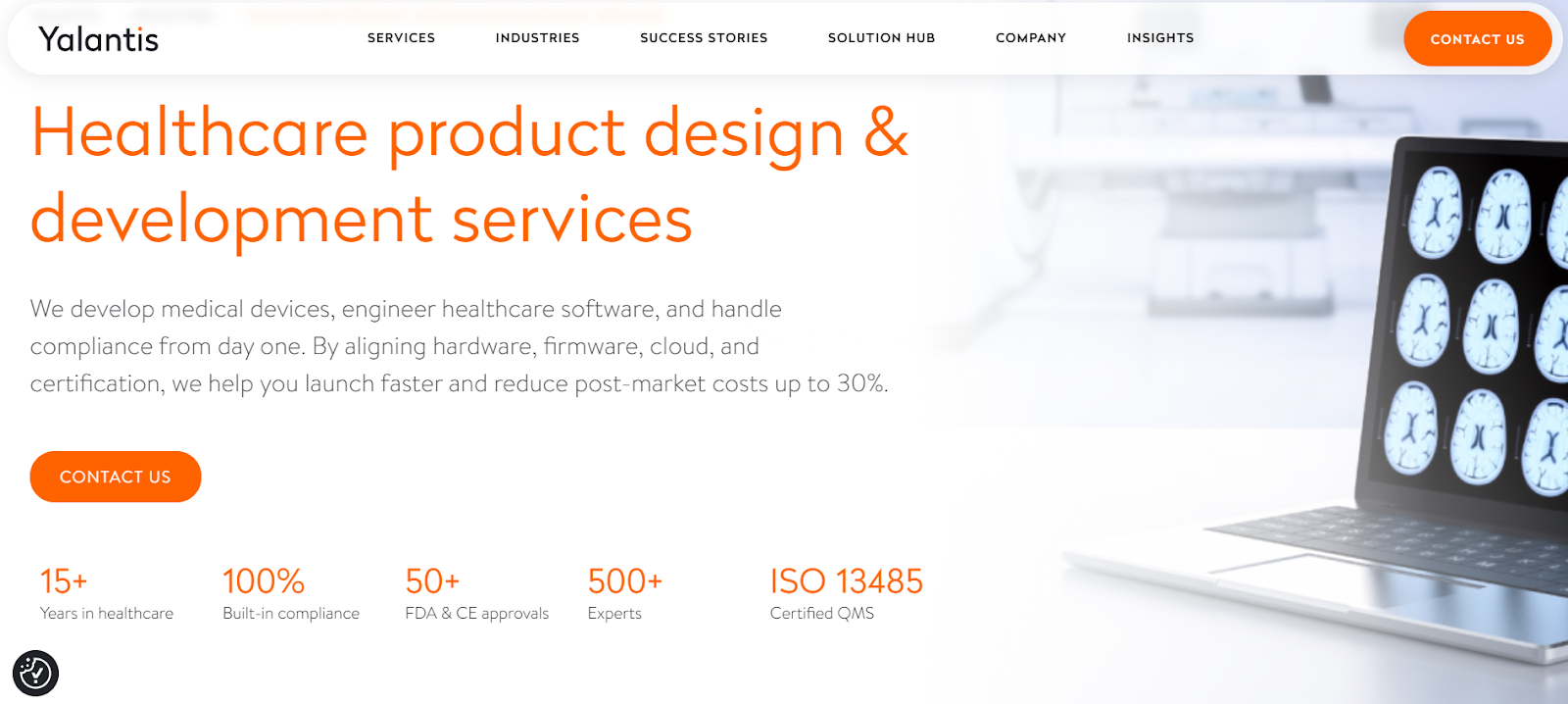
Founded in 2008, Yalantis has established itself as a unique force in European healthcare engineering. With over 2,000 employees distributed across Poland, Ukraine, Cyprus, and Estonia, the company has carved out a distinctive position by focusing on the convergence of hardware and software development, a critical capability as medical devices become increasingly connected and intelligent.
What truly sets Yalantis apart from traditional software development firms is its strategic commitment to Internet of Things healthcare solutions. Currently, approximately 40% of their projects involve IoT integration, and this proportion continues to grow as the healthcare industry embraces connected devices and remote monitoring technologies.
In November 2025, Yalantis announced a transformative strategic pivot that underscores its commitment to comprehensive product engineering. The company launched an in-house research and development laboratory in Warsaw dedicated to complete hardware lifecycle management, including industrial design, printed circuit board design, firmware development, prototyping, and rigorous testing protocols. This move positions Yalantis as one of the few firms capable of managing both hardware and software development under one roof.
Notable Healthcare Innovations and Capabilities
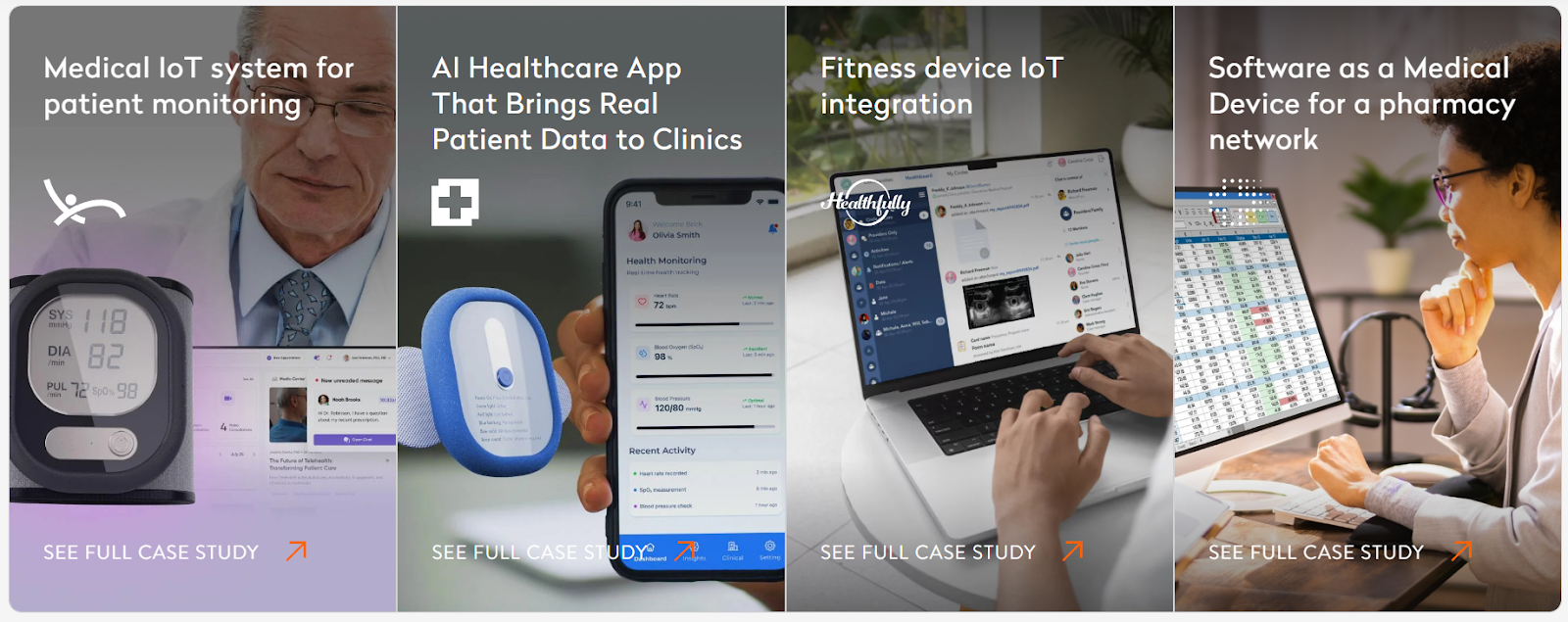
Yalantis has delivered several groundbreaking healthcare solutions that demonstrate its technical depth and regulatory expertise. Their AI-powered IoT healthcare monitoring application stands as a flagship achievement, a HIPAA and FDA-compliant system designed for ECG wearables that has been integrated across more than 60 major US hospitals. This implementation delivered a remarkable 30% revenue growth for their client, showcasing how well-executed digital health solutions can drive measurable business outcomes.
The company excels in medical device prototyping, having designed sophisticated wearable devices capable of monitoring ECG, oxygen saturation, and blood pressure. These devices are accompanied by comprehensive companion mobile applications and remote patient monitoring platforms that enable healthcare providers to track patient health in real-time, facilitating early intervention and reducing hospital readmissions.
Yalantis has also made significant contributions to Software as Medical Device development, creating specialized medication dosage calculation systems that help reduce medication errors, a critical patient safety concern. Additionally, their expertise extends to Electronic Health Record integration, where they facilitate secure connections between patient management systems and multiple third-party EHR solutions, ensuring seamless data flow across healthcare ecosystems.
Competitive Advantage in the Healthcare Market
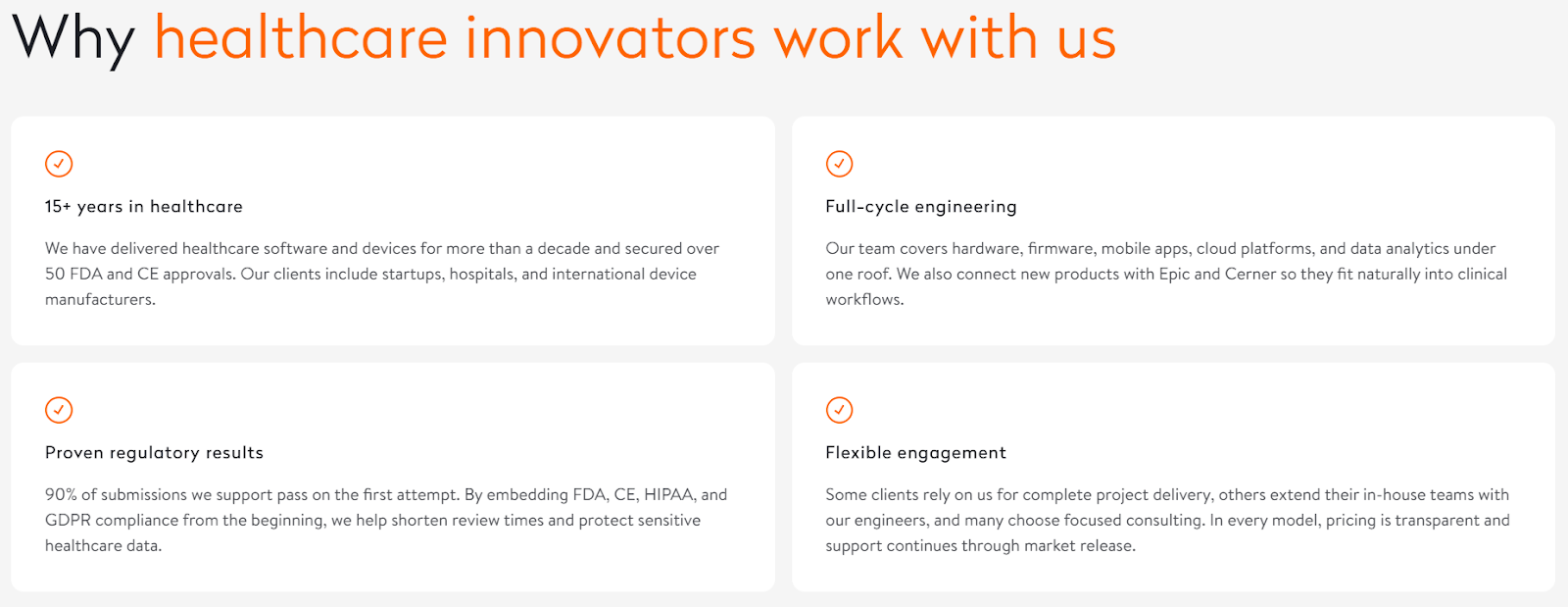
The primary competitive advantage Yalantis offers is its ability to bridge the traditionally separate worlds of hardware engineering and compliant software development. This capability enables rapid iteration from initial concept to FDA and HIPAA-ready products, a crucial differentiator as medical device IoT becomes increasingly central to digital health innovation.
For medical device companies and digital health startups developing connected health solutions, Yalantis provides an end-to-end development partner that can navigate complex regulatory requirements while maintaining the agility needed for iterative product development. Their Warsaw R&D lab allows them to control quality and accelerate timelines by managing all aspects of product development in-house rather than coordinating with multiple external partners.
2. EPAM Systems

EPAM Systems represents the enterprise heavyweight in healthcare product engineering, with over 55,000 employees and 2024 revenues exceeding $4.8 billion. The company specializes in building regulatory-compliant healthcare platforms with deep expertise in digital transformation, cloud architecture, and AI-driven solutions.
Their flagship Digital Clinical Trials Platform exemplifies their capabilities, a Microsoft Azure-based solution that connects patients, clinical research organizations, and healthcare providers to enable hybrid and decentralized clinical trials at scale. EPAM's approach combines advanced data science, DevSecOps practices, and enterprise-grade infrastructure, making it an ideal partner for large health systems, pharmaceutical companies, and payers requiring mission-critical digital transformation. Their capabilities span full-lifecycle product engineering, cloud modernization across Azure and AWS platforms, clinical decision support systems, and robust interoperability solutions supporting FHIR and HL7 standards.
3. ScienceSoft
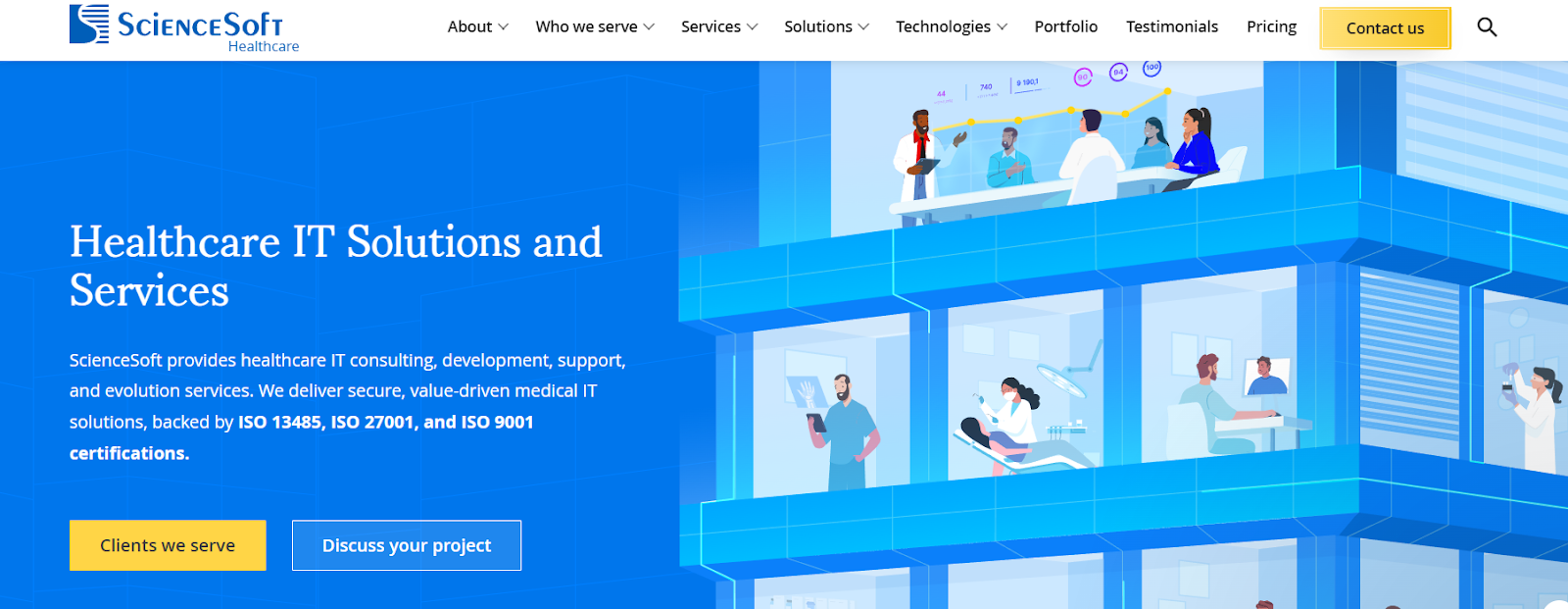
With 750 healthcare specialists and a dedicated focus on the sector since 2005, ScienceSoft brings profound domain knowledge to digital health challenges. Having delivered solutions for over 150 healthcare clients, the company has earned industry recognition for innovation and practical problem-solving.
ScienceSoft's competitive edge lies in a healthcare-specific digital transformation strategy that combines regulatory compliance expertise, legacy system modernization, and advanced analytics. Their AI-powered voice-based scheduling assistant represents one of the first real-time bidirectional voice tools deployed in production healthcare environments, demonstrating their focus on operational AI that delivers measurable workload reduction. The company employs principal architects with seven to twenty years of experience, follows HIMSS-aligned practices, and brings over 36 years of data analytics expertise to healthcare challenges.
4. Accenture
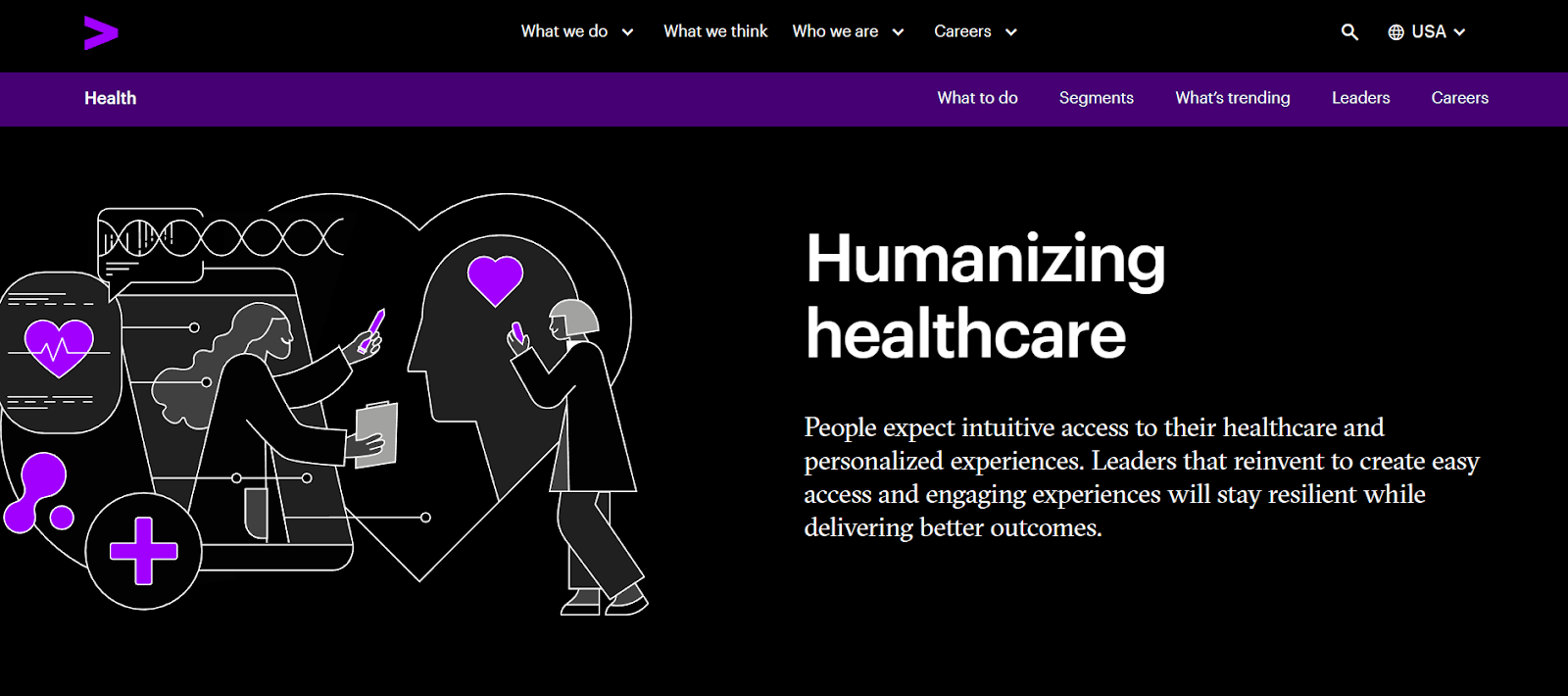
As a global enterprise leader with 355,000 employees, Accenture brings unmatched scale and AI capabilities to healthcare transformation. Their 2025 strategic focus emphasizes embedding intelligent agents directly into clinical workflows to handle ambient documentation, coding, prior authorization, and workflow automation. Rather than experimental AI pilots, Accenture drives production-grade implementations with measurable return on investment, making them the preferred choice for large health systems, national providers, and payers requiring enterprise-scale deployments with integrated change management.
5. Intellectsoft
Operating since 2007 with over a decade of dedicated healthcare focus, Intellectsoft combines custom software development with emerging technology integration. With seven offices spanning nine countries and a Fortune 500 client roster, the firm offers full-cycle healthcare product engineering from concept through production support. Their specializations include EMR and EHR systems, medical IoT, AI engines for treatment prediction, and compliance-ready development, all delivered through a global delivery model paired with healthcare regulatory expertise.
Digital Health Innovation Priorities for 2025-2026
The healthcare market is consolidating around five high-impact areas that should inform vendor selection decisions. Embedded AI-driven clinical decision support is moving away from standalone tools toward AI integrated directly into electronic health records, automating documentation and workflows to reclaim valuable clinician time. Interoperability and clean data infrastructure have become critical as regulatory enforcement of FHIR, USCDI+, and SMART on FHIR standards requires platform-agnostic data exchange.
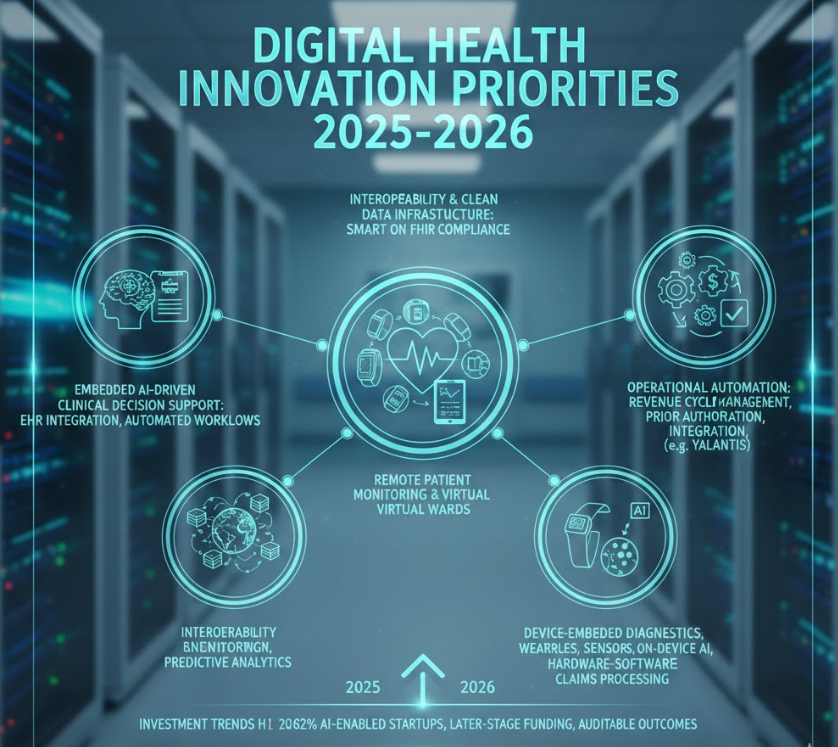
Remote patient monitoring and virtual wards are expanding globally, led by European innovations and combined with predictive analytics for high-risk patient management. Device-embedded diagnostics utilizing wearables and sensors with on-device AI require the hardware-software integration expertise where firms like Yalantis excel. Finally, operational automation in revenue cycle management, prior authorization, and claims processing has vendors competing on measurable throughput gains.
Investment trends reveal that in the first half of 2025, AI-enabled startups captured 62% of digital health funding, with investors increasingly favoring later-stage companies demonstrating evidence-based outcomes over early-stage pilots. Healthcare organizations now demand proof-of-concept with auditable outcomes before committing to scaled implementations.
Strategic Selection Framework
Selecting the right healthcare product engineering partner requires careful alignment between organizational needs and vendor capabilities. For enterprise health systems and payers, EPAM Systems or Accenture offer proven regulatory compliance, enterprise scale, and AI depth necessary for mission-critical transformations. Medical device companies and organizations developing IoT-enabled platforms should strongly consider Yalantis for their hardware-software integration capabilities, rapid prototyping expertise, and FDA and HIPAA compliance track record.
Healthcare providers focused on modernizing legacy systems will find ScienceSoft's deep healthcare operations knowledge, practical data analytics capabilities, and transformation strategy invaluable. Global digital health startups benefit from partnering with Intellectsoft or Yalantis, both of which offer agile delivery models, cost efficiency, and multi-regional presence essential for rapid market expansion.
The Future of Healthcare Product Engineering
The firms outlined in this analysis represent the current frontier of digital health innovation, each excelling in different dimensions, whether scale, IoT specialization, domain expertise, or enterprise agility. The most advanced healthcare organizations are those successfully combining operational AI with interoperable infrastructure, and the vendors discussed here are actively investing in both capabilities.
As the healthcare industry continues its digital transformation journey, the importance of selecting the right engineering partner cannot be overstated. Organizations must look beyond traditional criteria and evaluate vendors on their ability to navigate regulatory complexity, integrate emerging technologies, and deliver measurable outcomes. The convergence of hardware and software expertise, exemplified by firms like Yalantis, will become increasingly critical as connected medical devices and IoT-enabled care delivery models become the standard rather than the exception.