Why I’m Excited About VoltAgent, The Open-source TypeScript Framework for Building AI Agents

If you're like me, a developer who’s spent time juggling between no-code tools that feel too limiting and full-blown Python-based AI agent frameworks that demand way too much boilerplate, you’ll appreciate what VoltAgent brings to the table.
As someone who’s worked with both JavaScript/TypeScript and Python, I’ve seen the strengths of each ecosystem. But when it comes to building real-world AI agents, especially those that need to integrate smoothly with modern web apps, APIs, databases, and frontends, there’s something powerful about using a framework built in TypeScript.
So let me tell you why VoltAgent isn’t just another AI agent framework, it’s a game-changer, especially if you’re a full-stack or frontend-heavy developer.
What Is VoltAgent?
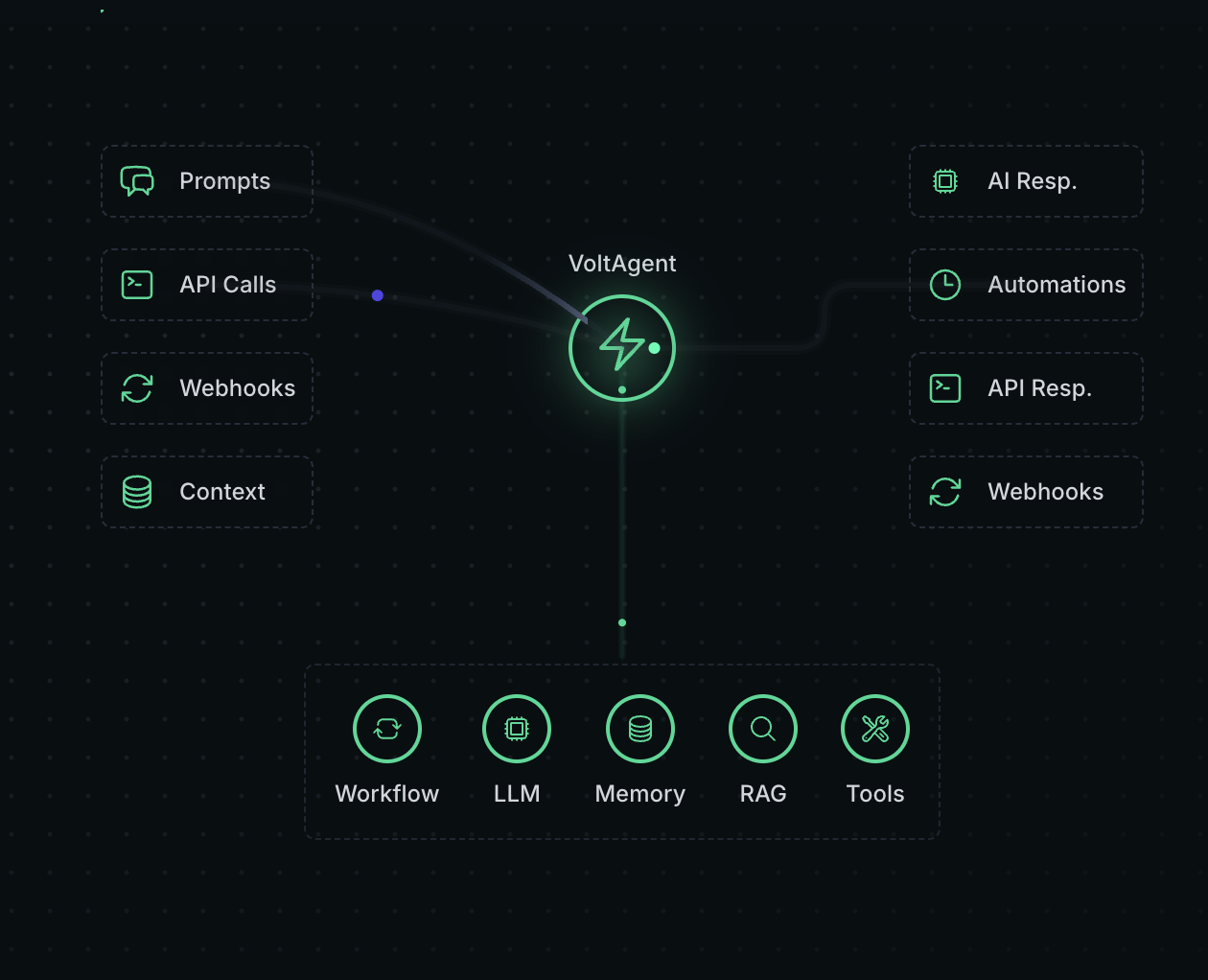
VoltAgent is an open-source TypeScript framework designed to make building AI agents fast, modular, and scalable, without forcing you to choose between simplicity and power.
It gives you:
- A clean, composable architecture
- Ready-to-use components (agents, supervisors, workflows)
- First-class support for async logic, parallel execution, and conditional branching
- Seamless integration with your existing JS/TS codebases
Think of it as the “React for AI agents”, where you define reusable pieces, compose them together, and focus on what your agent should do, not how to wire everything up.
With VoltAgent you can:
- Build Faster: Pre-built components = 10x speedup.
- Scale Smarter: Start simple → grow to complex multi-agent systems.
- Stay Flexible: Change models, tools, providers, no rewrites.
- Ship Confidently: Type safety + observability = fewer bugs, easier debugging.
- Avoid Lock-In: Open source, free, community-driven.
 Hazem Abbas
Who Is It For?
This framework is made for developers like you, whether you’re:
- A full-stack developer building AI-powered features into your web app.
- A frontend engineer tired of relying on backend-only AI logic and wanting more control.
- A product builder trying to prototype intelligent workflows quickly.
- Or even a Python dev who’s frustrated with the ecosystem sprawl and wants to work in a language they already know and love.
You don’t need to be an ML expert. You don’t need to manage Docker containers, LangChain configs, or complex prompt engineering pipelines manually. VoltAgent abstracts all that away, so you can build faster.
 Hazem Abbas
Features
- Agent Core: Define agents with roles, LLM providers, tools, and memory, zero boilerplate.
- Multi-Agent Systems: Use Supervisor Agents to orchestrate teams of specialized Sub-Agents.
- Workflow Engine: Declarative, powerful orchestration with
andThen,andAll,andRace,andWhen. - RAG & Data Retrieval: Built-in retriever agents for efficient knowledge fetching from any source.
- Memory Management: Persistent, configurable memory across interactions.
- LLM Agnostic: Seamlessly switch between OpenAI, Anthropic, Google, and more.
- Model Context Protocol (MCP) Support: Connect to external tool servers via MCP (HTTP/stdio).
- Type-Safe Tools: Zod-powered type validation + lifecycle hooks + cancellation support.
- Prompt Engineering Tools: Use
createPromptto build and manage reusable, effective prompts. - Custom API Endpoints: Extend the VoltAgent server with your own endpoints.
- VoltOps LLM Observability Platform: Visual monitoring of agent states, logs, tokens, and performance.
- @voltagent/cli & create-voltagent-app: Instant scaffolding, local dev, and workflow management.
- @voltagent/voice: Build voice-enabled agents with speech recognition and synthesis.
- Framework Compatibility: Integrates smoothly into Node.js apps and frameworks (Express, Next.js, etc.).
 Hazem Abbas
Why Build It in TypeScript? (Yes, Not Python)
Now, here’s the million-dollar question: Why not Python?
Most AI agent frameworks, LangChain, LlamaIndex, AutoGen, are written in Python because it’s the dominant language in data science and machine learning. That makes sense, but only if you’re working in that world.
But here’s the truth: most production applications aren’t pure ML labs. They’re web apps.
And when your AI agent needs to:
- Talk to a React frontend via WebSocket,
- Call a REST API,
- Store state in a PostgreSQL database,
- Trigger notifications,
- Run scheduled jobs,
...then being able to write all of it in one language, TypeScript, becomes a massive advantage.
As someone who’s built both Python and JS backends, I can say this:
The friction of switching between Python and JavaScript contexts kills velocity.
With VoltAgent, everything lives in the same codebase. You use the same types, same testing tools, same linters, same deployment pipeline. No context switching. No mental overhead.
Plus, TypeScript gives you:
- Strong typing (no more
undefinederrors from malformed JSON responses), - Better tooling (autocompletion, refactoring, IDE support),
- Easier collaboration across teams,
- And better maintainability over time.
So yes, even though Python dominates the AI space today, building AI agents in JavaScript/TypeScript is not just viable, it’s strategic, especially when you’re shipping real products.
 Hazem Abbas
What Can You Build With VoltAgent?
Let me give you some concrete examples of what you can actually build with VoltAgent, not just toy demos.
1. Smart Customer Support Assistant
Imagine a helpdesk chatbot that:
- Understands natural language questions,
- Pulls user data from your CRM (via API),
- Checks knowledge base articles,
- Escalates complex issues to human agents,
- Logs interactions in your database.
All while feeling seamless inside your web app, no backend black box needed.
With VoltAgent, you’d define:
- A
CustomerSupportAgentwith access to your CRM and FAQ tools, - A
SupervisorAgentto route queries, - And a workflow that runs steps in order, handles retries, and sends alerts.
Simple. Modular. Testable.
2. Automated Content Research Agent
You want to generate blog posts or reports based on current trends.
Your agent could:
- Search Google News and Reddit for trending topics,
- Summarize key points using LLMs,
- Compile sources into a structured markdown draft,
- Suggest titles and outlines,
- Even publish to your CMS via API.
Using VoltAgent’s Workflow Engine, you can run these steps in parallel, handle failures gracefully, and conditionally branch based on results.
No need to write custom orchestration logic from scratch.
3. Multi-Agent Project Planner (For Teams)
Imagine a team planning a product launch.
You set up:
- A
ResearchAgentto gather competitor insights, - A
DesignAgentto sketch UI concepts, - A
DevAgentto estimate timelines, - And a
ProjectSupervisorto coordinate all outputs.
Each agent has its own role, memory, and tools. The supervisor orchestrates the flow, checks progress, and flags blockers.
This isn’t sci-fi, or even a complex task matter, it’s possible today, with VoltAgent’s multi-agent system design.
4. Voice-Enabled Personal Assistant (with @voltagent/voice)
Want to build a voice-controlled assistant for smart devices or web apps?
With the @voltagent/voice package, you can:
- Capture speech input,
- Convert it to text,
- Route it to the right agent,
- Generate spoken responses using TTS.
Perfect for kiosks, accessibility tools, or interactive dashboards.
Real Benefits You Get
| Benefit | Why It Matters |
|---|---|
| Modular & Reusable Components | Build once, reuse across projects. No reinventing the wheel. |
| First-Class Workflow Orchestration | Handle complex sequences: call APIs, wait, retry, branch — all declaratively. |
| Built-in Memory & State Management | Agents remember past interactions, making conversations coherent. |
| Extensible via Packages | Add voice, file processing, database tools, etc., without rewriting core logic. |
| Full TypeScript Integration | Type safety, debugging, and IDE support throughout. |
Final Thoughts
I used to think AI agents were either too rigid (no-code) or too heavy (Python + LangChain). But VoltAgent bridges that gap, giving us the power of AI systems with the agility of modern web development.
As a developer who works in both worlds, I’m genuinely excited to see a framework that respects the realities of building real products: fast iteration, strong typing, tight integrations, and developer experience.
If you’re building anything involving AI agents, whether it’s a chatbot, automation engine, or multi-agent system, give VoltAgent a try.
It’s open source. It’s free. And it’s built for people who want to ship things, not just experiment. Start building smarter agents, in the language you already love.
Because the future of AI isn’t just about models. It’s about how we build with them, and honestly? I’m glad it’s finally getting easier.
 VoltAgent