16 Best Free Email OSINT Tools for 2026: Find Leaks, Breaches, and Social Profiles, Why Digital Hygiene is Important for Everyone Especially Healthcare Professionals


I logged into an old email last year to find a forgotten file and froze. Someone had logged in from halfway across the world, months after I thought I’d shut the account down. It wasn't a sophisticated hack, it was just old data coming back to haunt me.
It made me realize that an email address isn't just a way to chat; it's the key to your entire digital life. So, instead of waiting to get hacked, I decided to hunt down my own leaks first. I compiled this list of 16 OSINT tools to help you do the same. This isn't about being paranoid; it's about knowing what's out there so you can fix it.
However, before we start, as a healthcare professional, I have to note why these tools also are important for healthcare Cybersecurity.
Cybersecurity for Doctors & Nurses: How to Protect Your Digital Identity
As a medical doctor who also develops software for the healthcare sector, I stand at the intersection of patient care and data security. From this vantage point, I see a critical vulnerability that often goes unnoticed in our community: the gap between our physical hygiene and our digital hygiene.
In the hospital, we are rigorous about sterile fields. We scrub in, we gown up, and we obsess over infection control because we know that a microscopic breach can lead to catastrophic outcomes for our patients. Yet, when we step out of the OR and log into the digital world, that discipline often vanishes.
I recall a situation where a colleague, a brilliant specialist, used his personal email address to sign up for a niche medical journal years ago. He used the same password there that he used for the hospital's Electronic Medical Record (EMR) system. When that small journal's database was breached, it didn't just expose his reading habits; it handed attackers the potential keys to sensitive patient data. It wasn't negligence; it was simply a lack of awareness.
Healthcare professionals are high-value targets. Attackers know that the email you use for CME credits or conference registrations often leads back to hospital networks, patient portals, and NPI data. In our exhausted state after a 24-hour shift, we prioritize convenience, often reusing credentials across platforms without a second thought.
I included tools like Mosint and WhatBreach in this list not merely for security researchers, but as essential diagnostic instruments for us. You can use them to "triage" your digital identity. By running your primary email address through these tools, you can identify exposed credentials before they become a liability to your practice or your patients.
Think of this audit as preventative medicine for your professional life. It takes only minutes to diagnose your exposure, but it secures the trust that is the foundation of our profession. Just as we wouldn't touch a patient with unwashed hands, we shouldn't handle sensitive data with compromised accounts.
 Hazem Abbas
Here is our list:
1- Mosint
Mosint is a fast, automated OSINT tool I built in Go to investigate email exposure across the web. It aggregates data from breaches, social platforms, and public sources, all in one place.
No subscriptions, no tracking. Designed for privacy-first researchers and developers who value control. Runs efficiently on Raspberry Pi or any Linux system.
If you’ve ever wondered where your email has been used, Mosint gives you the answers, cleanly, quickly, and without compromise. Because digital hygiene shouldn’t be a mystery.
Mosint's features include:
- Fast and simple email-based scanning
- Optimized for ease of use and lightweight on resources
- Email verification and validation
- Checking Social Media Accounts
- Checking data breaches and password leaks
- Finding related emails and domains
- Scanning pastebin dumps
- Google Search
- DNS/IP Lookup
- Output to JSON file
- Print coffee with
--coffeeflag!
 alpkeskin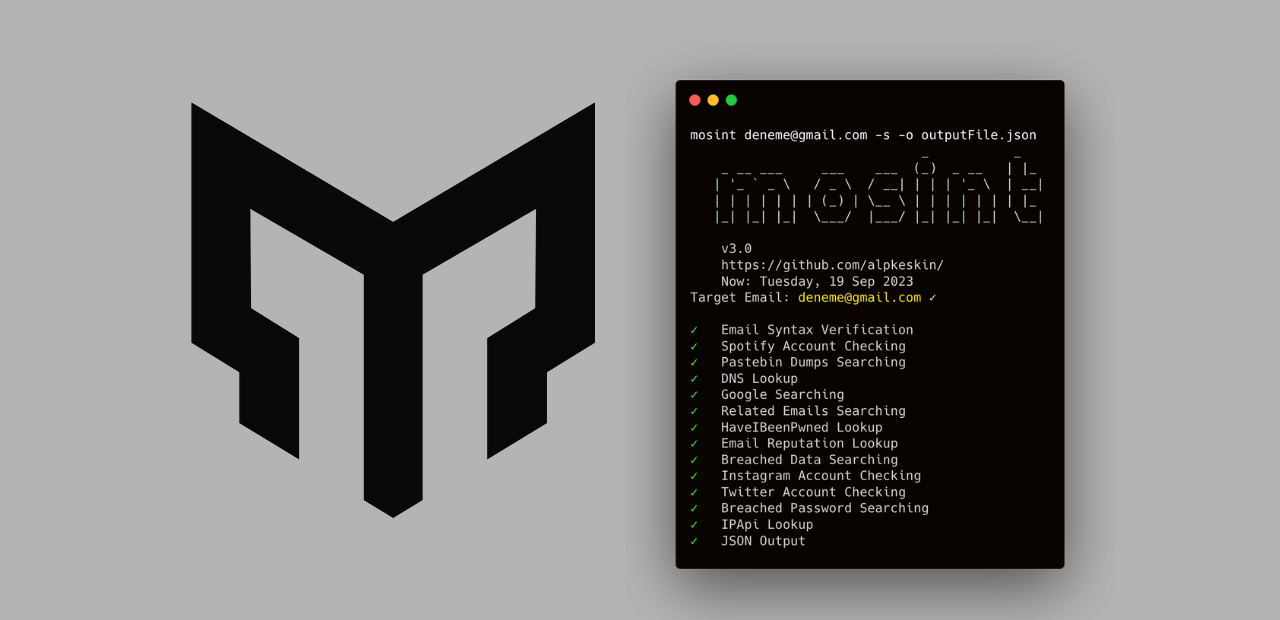
2- MailSleuth
MailSleuth is a fast, simple tool to check if an email appears on social media or other websites. It works for single emails or large lists from files. You can use proxies for privacy and adjust how many checks run at once for better speed. Built for efficiency, it’s great for quick OSINT lookups without the hassle.
MailSleuth include the following features:
- Check One Email Fast: Instantly see if a single email shows up on any supported platform.
- Process Many Emails at Once: Upload a file with dozens or hundreds of emails for bulk checks. Perfect for investigations.
- Stay Anonymous with Proxies: Use a single proxy or a list from a file to hide your IP and avoid detection.
- Control Speed & Load: Adjust how many checks run at the same time, balance speed without overloading your system.
- Save Results Your Way: Export findings to JSON for easy review, analysis, or reporting.
- See What’s Supported: Quickly check which platforms MailSleuth can scan, no guesswork.
 Hazem Abbas
3- Poastal
Poastal is an email OSINT tool that provides valuable information on any email address. With Poastal, you can easily input an email address and it will quickly answer several questions, providing you with crucial information.
Poastal's features include:
- Determine the name of the person who has the email.
- Check if the email is deliverable or not.
- Find out if the email is disposable or not.
- Identify if the email is considered spam.
- Check if the email is registered on popular platforms such as Facebook, Twitter, Snapchat, Parler, Rumble, MeWe, Imgur, Adobe, Wordpress, and Duolingo.
4- Mailogle
Mailogle is an OSINT tool that helps find email addresses on websites like GitHub, Spotify, Instagram, and Snapchat. This tool is useful for gathering open-source intelligence in a simple way.
5- h8mail
h8mail is a simple, powerful tool to help you find where an email has been exposed, especially in data breaches. It works by checking your email against real breach databases like Troy Hunt’s “Collection1” and the massive “Breach Compilation” torrent (yes, it even handles that!).
h8mail's features:
- Use regular expressions to match email patterns, making it easy to pull emails from other tools’ output.
- Paste a URL and h8mail will scan the page to extract any emails found.
- Search using loose patterns like “john.smith” or “evilcorp”, perfect for guessing or scanning large datasets.
- Install it in seconds with pip, only requires the requests library.
- Process hundreds of emails at once by reading from a file.
- Save results directly to CSV or JSON for analysis or reporting.
- Work with local breach files, including compressed .gz files, using fast multiprocessing.
- Check against well-known datasets like Troy Hunt’s Collection#1 and the full "Breach Compilation" torrent.
- Automatically find related emails from known sources and add them to your ongoing search.
- Extend the hunt by chasing down linked accounts or identities.
- Connect to premium lookup services (like HaveIBeenPwned) for deeper insights, even query by username, domain, IP, hash, or password.
- Run custom API queries for advanced users who need more control.
- Group all breach results across targets and methods into one clean overview.
- Optionally hide passwords when showing results, ideal for demos or presentations.
- Enjoy a colorful, user-friendly interface that makes scanning feel less like work and more like detective mode.
6- MailFinder
MailFinder is a free and open-source OSINT tool for finding email by first and last name.
8- Holehe
Holehe is a fast, privacy-first Python tool that checks if an email is linked to over 120 websites by testing their password reset pages — silently, safely, and without triggering alerts.
It returns clean results in JSON format, showing which platforms the email appears on, along with recovery info, and works great for OSINT, audits, or scripting.
9- Zehef
Zehef is a focused OSINT tool designed to uncover public information tied to a specific email address. It checks for pastes on sites like Pastebin, scans breach databases via HudsonRock, and searches across social platforms including Instagram, Spotify, Deezer, Adobe, and X (formerly Twitter).
It also generates common email variations to expand the investigation, helping users find hidden or related accounts.
Use cases include digital forensics, security audits, threat intelligence, background checks, and privacy assessments.
Researchers, investigators, and developers use Zehef to map an email’s digital footprint, all without alerts, logs, or notifications, making it ideal for discreet, ethical reconnaissance.
10- Gumshoe
Gumshoe is a Python-powered OSINT tool, you can think of it as your private detective, that helps you uncover public information by searching through usernames, emails, or domains. It uses dedicated modules for each type of query, keeping things clean and focused.
11- Mail Osint Tools
mail-osint-tools is a secure toolkit for investigating email addresses. It uncovers linked data like social media profiles, phone numbers, and data leaks. Designed for simplicity and safety, it helps you effectively gather open-source intelligence while prioritizing your privacy.
The good news, is it works on Windows, Linux and macOS.
12- Eyes
Eyes is a stealthy, fully asynchronous OSINT tool that uncovers online accounts linked to an email. It identifies specific profiles, even with mismatched usernames, via a fast CLI, without alerting the target.
It supports async scrapping and it is fairly easy to use.
13- git2mail
git2mail is a fast, Rust-based OSINT tool that extracts developer email addresses from GitHub commits and repositories, supporting bulk scans.
14- Email OSINT tool
Email OSINT tool, emailfinder collects emails from different sources like Google, DuckDuckGo, Bing, Yahoo, Yandex, Github, etc.
15- WhatBreach
WhatBreach is an OSINT tool designed to identify data breaches linked to specific email addresses. It allows users to search single or multiple emails to discover known compromises. Beyond simple detection, the tool can download publicly available breached databases and pastes containing the target email, as well as investigate the email's domain for further intelligence.
The tool relies on the HaveIBeenPwned API (which requires a paid subscription) and other sources to aggregate this data.
It also uses several API to achieve the same results and check for the leaked emails.
16- WWW.py
WWWE.py is a standalone Python script that checks an email or a list of emails using popular online services to see it the email(s) appear on any security-breach happened in the past. It uses several search engines to do that.
Final Thought
Digital hygiene isn’t about paranoia; it’s about awareness. The internet has a long memory, and your email address is the thread tying your entire digital history together. As I learned the hard way, leaving old accounts dormant doesn't mean they are safe, it just means they are unmonitored.
You now have a toolkit of 16 powerful engines to audit your footprint. Whether you use Mosint for a deep dive, Holehe to check for registered accounts, or WhatBreach to assess damage, the goal is the same: to shift from being a passive victim to an active owner of your data. Don't wait for a suspicious login notification to wake you up. Pick a tool, run a scan, and see what the internet knows about you.
Read More
 Hazem Abbas
 Hazem Abbas
 Hazem Abbas
 Hazem Abbas