The AI Invisible Safety Net: How AI is Auditing and Elevating Healthcare Quality


Every day, I switch between two very different worlds. In the clinic, I wear the white coat, holding a patient’s hand, listening to their heartbeat, and making life-altering medical decisions. Later, I take off the coat, put on my developer hat, and stare at lines of code, designing AI systems that process health data.
People often ask me how these two worlds connect. The answer lies in a concept that sounds intimidating but is actually deeply compassionate: Auditing.
When you hear the word "audit," you probably think of the IRS, endless paperwork, or someone looking over your shoulder to catch you doing something wrong. But in healthcare, an audit is simply a "health check" for the hospital itself. It is how we ensure that the care we provide is safe, effective, and kind.
Historically, auditing healthcare quality meant humans manually reviewing thousands of paper charts—a slow, exhausting, and imperfect process. Today, Artificial Intelligence is changing the game. AI is no longer just a tool for diagnosing diseases; it is becoming the ultimate, tireless quality inspector.
Let’s break down, in plain English, how AI is auditing the different layers of healthcare to protect patients and support the humans who care for them.
1. Auditing the Clinical Flow (The Medical Journey)
What it is: The clinical flow is the medical journey a patient takes. It starts when you describe your symptoms, moves through the tests we order, the diagnosis we make, and the treatment plan we prescribe.
How AI helps: As a doctor, I rely on clinical guidelines—massive rulebooks that tell us the best way to treat specific conditions. But in a busy 12-hour shift, it is easy for a human brain to miss a minor step. AI acts as a real-time co-pilot. It continuously audits the clinical flow in the background. If a patient comes in with specific symptoms and a certain blood test result, the AI instantly checks if the standard protocol was followed. Did we prescribe the right antibiotic? Did we order the follow-up scan? If a step is missed, the AI gently nudges the doctor’s screen. It ensures that every patient receives the exact same high standard of evidence-based care, regardless of how tired the medical team might be.
2. Auditing the Patient Flow (The Logistics)
What it is: If clinical flow is the medicine, patient flow is the logistics. It is the physical journey: checking in at the front desk, waiting in the ER, getting a hospital bed, and eventually being discharged.
How AI helps: Hospitals are a bit like busy airports, and sometimes, the system gets gridlocked. From an engineering perspective, patient flow is a complex math problem. AI audits this flow by predicting bottlenecks before they happen. By analyzing historical data, current ER wait times, and even local weather or flu trends, AI can forecast how many beds will be needed next week. It audits the "waiting experience," alerting administrators to redirect staff to overcrowded waiting rooms or speed up discharge paperwork. For the simple person, this means less time sitting on a hard plastic chair in the ER, and more time resting in a proper bed.
3. Auditing Individual and Team Performance
What it is: This is about how well the healthcare team is functioning. But let me be clear: this is not about AI spying on doctors to see who works the slowest.
How AI helps: In a healthy system, performance auditing is about support, not punishment. AI analyzes the workload and environment of the medical staff. It can audit shift patterns and alert management if a nursing unit is consistently understaffed or if a specific doctor is being scheduled for too many back-to-back night shifts. By auditing the conditions of work, AI helps prevent burnout. A well-rested, supported doctor is a safer doctor. AI ensures the human beings delivering the care are being taken care of themselves.
4. Auditing Overall Hospital Performance
What it is: This is the big picture. It looks at macro-level metrics: How many patients are readmitted within 30 days? Are infection rates going up or down? Is the hospital effectively managing chronic diseases in the local community?
How AI helps: Humans are great at looking at individual patients, but we are terrible at seeing massive, hidden patterns across tens of thousands of records. AI excels here. It audits the overall health of the hospital by connecting dots that no human could see. For example, an AI might notice that patients discharged on Friday afternoons have a 15% higher chance of being readmitted due to medication confusion. The hospital can then change its Friday discharge protocols. AI turns a hospital from a reactive building into a proactive, learning organism that constantly improves its overall quality of care.
5. Auditing Security and Privacy
What it is: Your medical record is the most sensitive data you own. Auditing security means ensuring that hackers can’t steal it, and that the hospital itself isn’t accidentally leaking it.
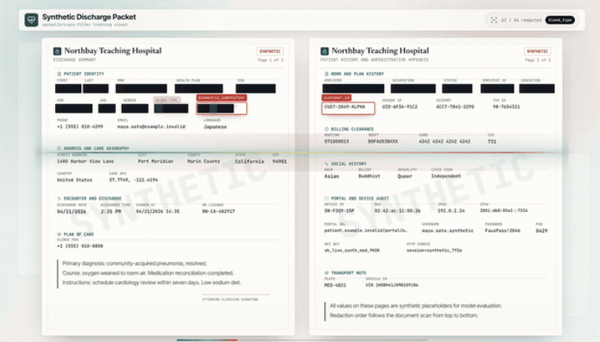
How AI helps: As a privacy advocate and developer, this is an area I care deeply about. Traditional security is like a castle wall; once a hacker gets inside, they have free rein. AI acts as an intelligent security guard walking the halls 24/7. It audits network traffic in real-time, looking for the subtle, weird behaviors that indicate a data breach. Furthermore, we are now using local, open-source AI models to automatically scan and redact sensitive information (like names and Social Security numbers) before data is even used for research. By keeping the AI local and privacy-first, we ensure that auditing the system doesn't compromise the patient's trust.
6. Finding Medical Errors and Preventing Malpractice
What it is: This is the most critical, emotional part of healthcare. Medical errors—like giving the wrong medication dosage, missing a subtle sign of sepsis, or misinterpreting an X-ray—are a leading cause of harm. "Malpractice" is the legal term for when these errors cause injury, but for doctors, it represents our deepest fear: hurting the person we swore to heal.
How AI helps: Most medical errors are not caused by bad intentions; they are caused by human fatigue, distraction, or the sheer complexity of modern medicine. AI is the ultimate "second set of eyes."
- Medication Safety: AI audits every prescription, instantly flagging dangerous drug interactions or incorrect dosages based on the patient's kidney function, long before the pharmacist sees it.
- Diagnostic Safety: AI algorithms can scan X-rays and MRIs, highlighting tiny anomalies that a tired radiologist might miss at 3:00 AM.
- Chart Auditing: AI reads the doctor's notes and cross-references them with the patient's actual lab results, flagging contradictions.
By catching these errors before they reach the patient, AI doesn't just prevent malpractice lawsuits; it prevents tragedies. It acts as an invisible safety net, catching the honest mistakes that humans inevitably make when they are pushed to their limits.
The Human Element in an AI World
It is easy to look at this list and feel like healthcare is becoming a cold, robotic process. But the opposite is true.
As a physician, I didn't go to medical school to stare at spreadsheets, manage hospital bed logistics, or act as a human spell-checker for drug dosages. I went to medical school to look into a patient's eyes, to hold their hand when they are scared, and to heal.
When AI takes over the exhausting, complex task of auditing quality, flow, and safety, it gives doctors and nurses their most precious resource back: time. Time to actually talk to you. Time to listen. Time to care.
AI is not here to replace the human touch in healthcare. It is here to audit the machinery of the hospital, so that the humans inside it can focus entirely on what they do best: caring for you.
About the Author
The author is a physician, software engineer, and father who operates at the intersection of clinical medicine and open-source technology. Through platforms like Medevel, he advocates for privacy-first, local AI solutions that empower healthcare providers and protect patient data, believing that true innovation must always be rooted in compassion.