Why Modern Developers Should Understand Loop Engineering? and How Can They Use It?

What is Loop Engineering?
Loop Engineering is a paradigm shift in how developers interact with AI coding agents (such as Claude Code, Codex, Grok, Cursor, etc.).
Instead of manually writing individual prompts for every task, you design automated systems ("loops") that continuously prompt, orchestrate, and manage the AI agents over time.
The Core Concept:
- Old Way: You act as the prompter. You type a request, wait for the AI, review it, and type another request.
- New Way (Loop Engineering): You act as the system designer. You build a "loop" that automatically discovers tasks, prompts the agent, executes code, verifies results, and reports back to you.
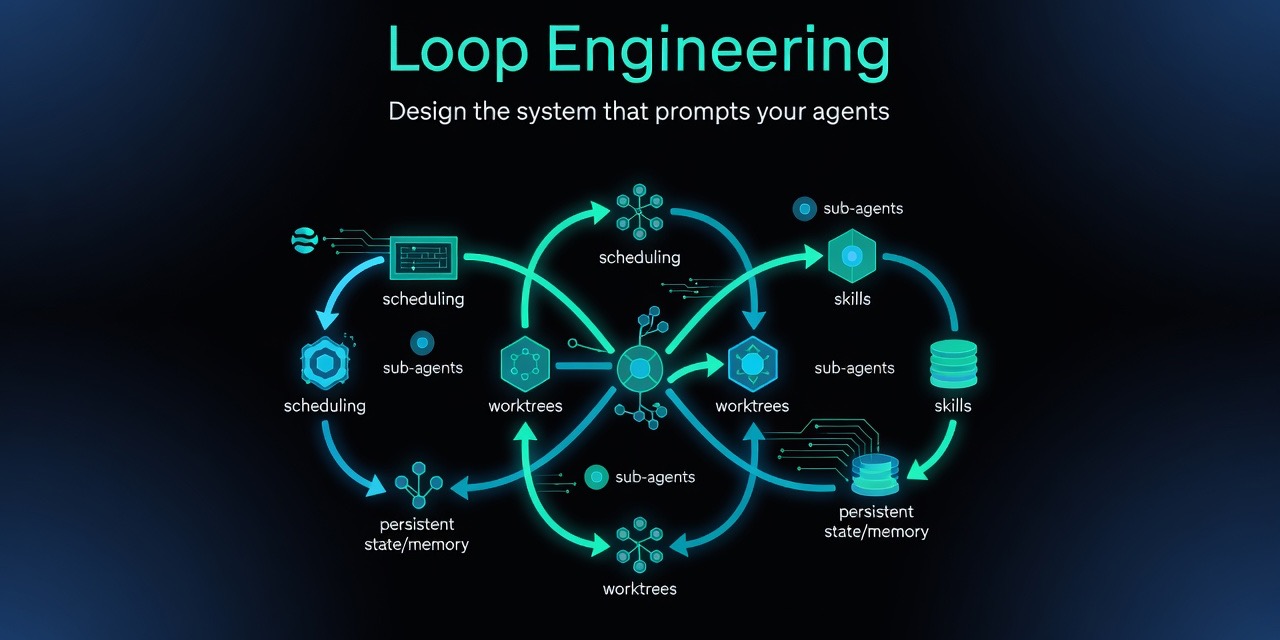
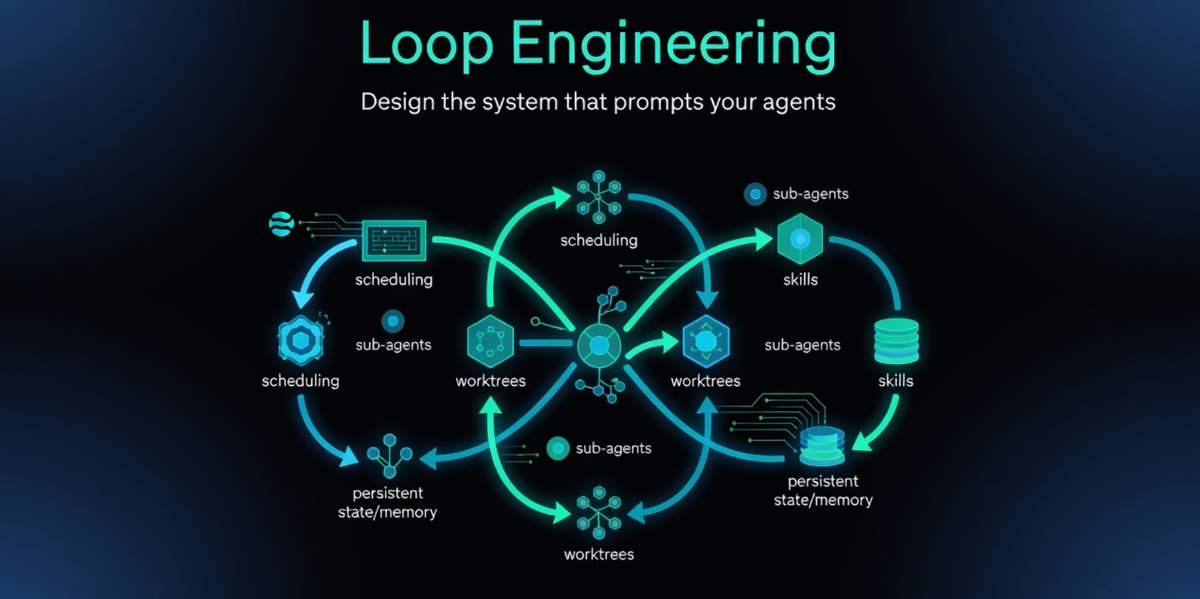
The Five Building Blocks of a Loop:
- Automations/Scheduling: Triggers the loop on a cadence (e.g., every 15 minutes or daily).
- Worktrees: Uses isolated Git branches to allow safe, parallel execution without breaking the main codebase.
- Skills: Persistent project knowledge that the agent can reference across different runs.
- Plugins & Connectors (MCP): Allows the agent to interact with real-world tools (like Jira, Slack, or CI pipelines).
- Sub-agents: Splits work between a "Maker" (writes code) and a "Checker" (reviews code).
- + Memory/State: A durable record (outside the chat window) that tracks what has been done, ensuring continuity between runs.
Why is This Project Important?
This project (cobusgreyling/loop-engineering) is significant because it addresses the maturity gap in AI-assisted development. As AI agents become more capable, the bottleneck moves from "can the AI write code?" to "how do we safely and efficiently manage the AI at scale?"
Here are the key reasons for its importance:
1. Shifts Leverage from Prompting to System Design
As noted by industry leaders quoted in the repo:
- Boris Cherny (Head of Claude Code at Anthropic): "I don’t prompt Claude anymore. I have loops running that prompt Claude... My job is to write loops."
- Peter Steinberger: "You shouldn’t be prompting coding agents anymore. You should be designing loops that prompt your agents."
This project provides the practical toolkit to make that shift possible, moving developers from manual interaction to architectural oversight.
2. Provides Production-Ready Patterns
It doesn’t just offer theory; it provides 7 specific, tested patterns for common engineering tasks, such as:
- Daily Triage: Automatically reviewing new issues.
- PR Babysitter: Monitoring and commenting on Pull Requests.
- CI Sweeper: Fixing broken builds automatically.
- Dependency Sweeper: Updating libraries safely.
3. Solves Critical Safety & Cost Problems
AI agents can be expensive and dangerous if left unchecked. This project introduces tools to mitigate these risks:
loop-cost: Estimates token spend before you run a loop, preventing budget explosions.loop-audit: Gives your project a "Loop Ready Score," checking for safety constraints and governance.loop-worktree: Ensures AI changes happen in isolated environments, so bad code doesn’t break your main branch.loop-context: Acts as a circuit breaker and memory manager to prevent agents from getting stuck in infinite loops or losing context.
4. Standardizes the Workflow
It offers a standardized way to scaffold, run, and monitor AI loops across different tools (Grok, Claude, Codex, etc.). By using loop-init, developers can quickly set up the necessary state files, budget limits, and constraints, reducing the friction of adopting AI automation.
5. Focuses on "Comprehension Debt"
The project acknowledges that while AI can write code fast, humans still need to understand it. It emphasizes verification and logging, ensuring that even if a loop runs unattended, the human engineer remains in control and aware of what changed.
In Summary
Loop Engineering is important because it transforms AI from a chatbot assistant into an autonomous engineering team member. This repository provides the essential infrastructure, safety rails, and best practices to make that transformation reliable, cost-effective, and scalable for professional software development.
 cobusgreyling