Unlocking Smarter Healthcare: Meet the Open-Source Medical MCP Server


Here at Medevel.com, we’re always thrilled to stumble upon new open-source projects that aim to make a genuine difference in healthcare. The fusion of AI and medicine holds incredible promise, but it's the practical, accessible tools that truly move the needle.
When we find an open-source software that empowers clinicians, researchers, and students by putting authoritative information at their fingertips, we can't wait to share it.
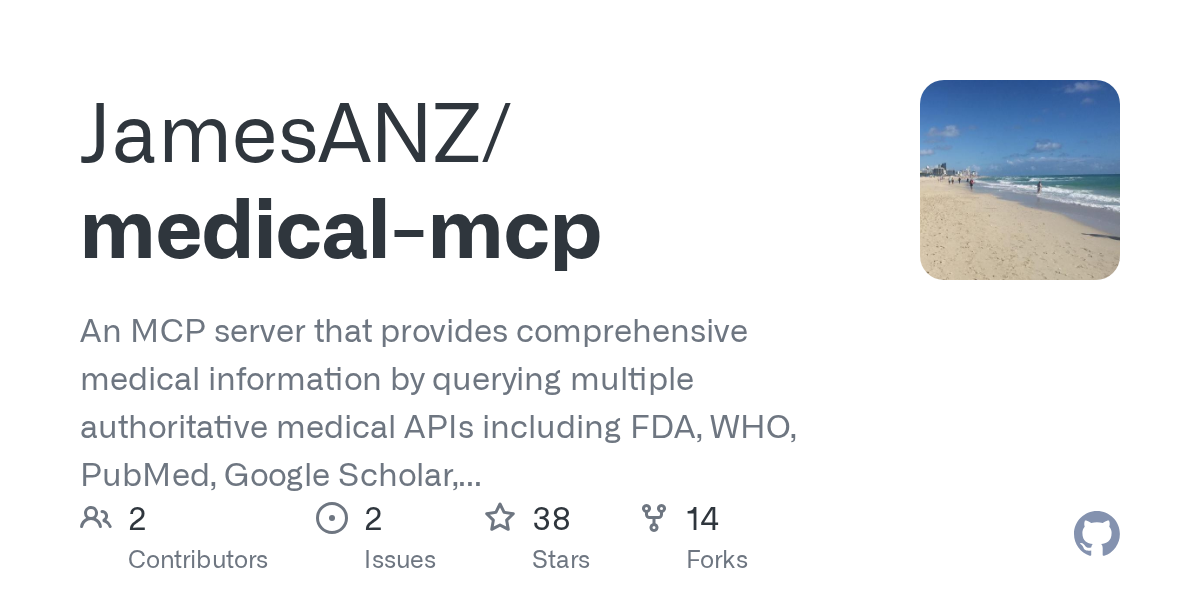
Today, we’re excited to dive into one such project: the Medical MCP Server by JamesANZ.
But before we get into the specifics of this brilliant tool, let's quickly cover the foundational technology that makes it possible: the Model Context Protocol, or MCP.
What is MCP, and Why Should Healthcare Care?
Imagine you have a brilliant AI assistant, like Claude or ChatGPT, but its knowledge is limited to what it was trained on up to a certain point. It can't access real-time drug databases, pull the latest medical research, or fetch current health statistics. This is where MCP comes in.
The Model Context Protocol (MCP) is a new open standard that acts as a universal bridge between AI models and external tools, data sources, and services. You may think of it like a set of USB-C ports for your AI. An MCP Server is a specialized piece of software that plugs into this port, providing the AI with a specific set of capabilities.
In this case, the Medical MCP Server plugs into your AI and gives it the power to query real-world medical databases. You can ask your AI assistant, "What are the latest treatment guidelines for condition X?" or "What are the potential interactions between these two drugs?" and it can use the MCP server to fetch that live, authoritative data for you, seamlessly integrating it into your conversation.
Why is this a game-changer for healthcare? The answer lies in workflow and quality. The modern clinical workflow is bogged down by tab-switching, logins, and manual searches across dozens of different platforms. This fragmentation is a silent killer of efficiency and can impact healthcare quality.
MCP offers a path toward a unified, conversational interface for information retrieval. It’s a giant leap forward for healthcare AI integration, moving AI from a generic chatbot to a specialized clinical co-pilot that understands the specific tools and data sources of the medical world.
 Hazem Abbas
Introducing the Medical MCP Server: Your AI's New Medical Library
So, what exactly is this project? The Medical MCP Server is an open-source tool that transforms any MCP-compatible AI into a medical research powerhouse. It does this by providing a suite of tools that query some of the world's most authoritative medical APIs, including:
- FDA Database: For official drug labeling, safety info, and recalls.
- PubMed: For searching millions of medical research articles.
- WHO Global Health Observatory: For global health statistics and indicators.
- RxNorm: For standardized drug nomenclature to avoid confusion between brand and generic names.
- Google Scholar: For broadening research to include academic papers and theses (via a clever, respectful web scraping tool).
Instead of you having to navigate to each of these sites, the MCP server allows your AI to do the legwork for you, synthesizing the information into a clear, concise summary.
 Hazem Abbas
7 Powerful Use-Cases in Clinical and Research Workflows
Let's get practical. How can this tool be used day-to-day? Here are seven compelling use-cases that demonstrate its potential to enhance the clinical workflow:
- Rapid Drug Information at the Point of Care: A physician with a patient in the exam room can ask their AI, "Quickly summarize the key warnings and common side effects of Metformin." The AI uses the
search-drugstool to pull the latest FDA data instantly, saving a manual search on a drug database website. - Comprehensive Literature Reviews for Research: A medical student or researcher beginning a project on "novel COVID-19 treatments" can use the
search-medical-literatureandsearch-google-scholartools to generate a preliminary list of recent, high-impact papers in seconds, complete with abstracts and citation counts. - Pre-consultation Drug Interaction Checks: Before prescribing a new medication, a clinician can use the
check-drug-interactionstool (via the underlying FDA data) to screen for potential conflicts with the patient's existing medication list, adding a layer of safety to the prescribing process. - Generating Differential Diagnoses: When presented with a complex set of symptoms (e.g., chest pain, shortness of breath), a clinician can use the
generate-differential-diagnosistool.
The AI can leverage its medical knowledge and the MCP server's access to diagnostic criteria to suggest a ranked list of possibilities to consider. - Public Health and Epidemiological Analysis: A public health officer can use the
get-health-statisticstool to quickly pull WHO data on life expectancy or disease prevalence across different countries, providing valuable context for a report or presentation. - Standardizing Medication Lists: A pharmacist or health IT professional can use the
search-drug-nomenclaturetool with RxNorm to resolve brand names to their standard generic names, ensuring clarity and reducing errors in electronic health records. - Medical Education and Training: An educator preparing a lecture can use the server to gather the most recent clinical guidelines, drug information, and supporting research articles, creating rich, up-to-date educational materials for students.
 Hazem Abbas
A Tour of the Features: What's Under the Hood?
This MCP server is packed with thoughtfully designed features:
- Multi-Source Drug Intelligence: It doesn't rely on a single source. You can search the FDA by brand name and get detailed safety profiles by National Drug Code (NDC).
- Global Health Data Access: Tap into the WHO's vast repository for country-specific health indicator data.
- Dual-Pronged Literature Search: Combine the clinical focus of PubMed with the broad academic scope of Google Scholar for a comprehensive research sweep.
- Clinical Decision Support Tools: Features like differential diagnosis generation and diagnostic criteria lookup move beyond simple search into active clinical support.
- Secure & Private: The server runs locally on your machine. Your queries don't get sent to a third-party cloud; the server fetches data directly from the source APIs, keeping your workflow private.
- Robust and Reliable: It includes sophisticated error handling and, for the Google Scholar tool, intelligent rate-limiting to ensure stable and respectful access.
 Hazem Abbas
How to Get Started: Installing Your Medical AI Co-Pilot
Getting this powerful tool integrated with an AI like Claude Desktop is refreshingly straightforward. Here’s a simplified guide:
- Get the Code: Clone the repository from GitHub using Git.
- Install Dependencies: Navigate to the project folder and run
npm installto grab all the necessary components. - Build the Server: Run
npm run buildto compile the code into a ready-to-run application.- Example Configuration:
- Restart and Go! Restart your AI application, and you’re all set! You’ll now see new medical tools available when you chat.
Configure Your AI: This is the key step. You need to edit your AI client's configuration file to point to this new server.
For Claude Desktop, you’d add a section that essentially says, "Hey Claude, when you start up, also run this Medical MCP Server and connect to it."
{
  "mcpServers": {
    "medical-mcp": {
      "command": "node",
      "args": ["/ABSOLUTE/PATH/TO/medical-mcp/build/index.js"]
    }
  }
}
 Written byAshish Singh, Kuldeep Singh, and Mridul Saran
The Future is Integrated Healthcare
The Medical MCP Server is a perfect example of the next wave of healthcare AI integration. It’s not about replacing clinicians but about augmenting them.
By reducing the friction of information retrieval, it allows healthcare professionals to focus on what they do best: critical thinking, empathy, and patient care.
This project shines a light on the future of the clinical workflow, one that is more intuitive, efficient, and informed, ultimately contributing to a higher standard of healthcare quality.
We applaud JamesANZ and contributors for building and sharing this fantastic open-source tool. It’s through projects like these that we collectively build a smarter, more responsive future for healthcare.
Medical Disclaimer: This tool is designed for informational and educational purposes to support clinical workflow and research. It is not a substitute for professional medical judgment, diagnosis, or treatment.
Always verify critical information through primary sources and consult with qualified healthcare professionals for medical decision-making.
License
The app is released under the open-source MIT License.
Resources & Downloads
 JamesANZ