reNgine: The Ultimate Open-Source Web Recon & Vulnerability Scanner

What is reNgine?
reNgine is an open-source, automated web application reconnaissance and vulnerability scanning suite. It is designed for security professionals, penetration testers, and bug bounty hunters who need to gather comprehensive intelligence on target websites efficiently. Think of it as a command center that orchestrates multiple specialized security tools into one unified, easy-to-use interface.
What does it do?
Instead of manually running dozens of different scripts and tools, reNgine automates the entire reconnaissance workflow:
- Automated Reconnaissance: It chains together industry-standard tools (like Subfinder, Amass, Nuclei, and Naabu) to perform subdomain enumeration, port scanning, directory brute-forcing, and technology detection.
- Vulnerability Scanning: It integrates with engines like Nuclei to automatically scan discovered assets for known vulnerabilities and misconfigurations using customizable templates.
- Continuous Monitoring: It doesn’t just run once; it can continuously monitor targets for new subdomains or changes in infrastructure, alerting you to new attack surfaces as they appear.
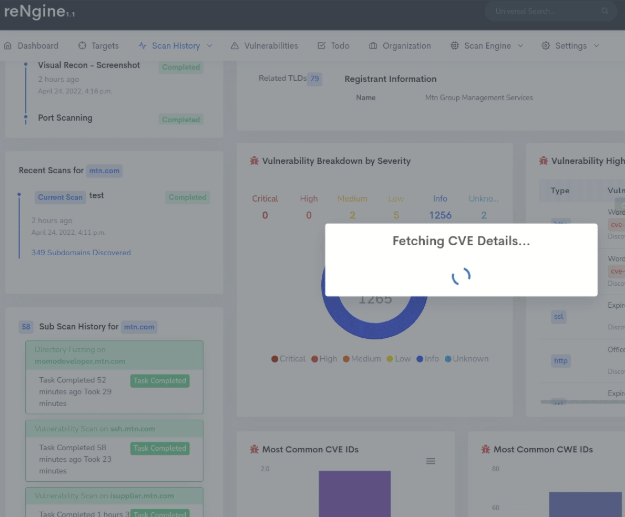
- Data Correlation & Visualization: It stores all findings in a database and presents them through an intuitive dashboard, allowing you to visualize relationships between domains, IPs, and technologies.
- Bug Bounty Integration: The latest version includes a "Bounty Hub" to sync with platforms like HackerOne, helping you manage programs and scope directly within the tool.
In short, reNgine turns the chaotic, manual process of web reconnaissance into a streamlined, automated, and data-driven workflow.
Features
- Reconnaissance:
- Subdomain Discovery
- IP and Open Ports Identification
- Endpoints Discovery
- Directory/Files fuzzing
- Screenshot Gathering
- Vulnerability Scan
- Nuclei
- Dalfox XSS Scanner
- CRLFuzzer
- Misconfigured S3 Scanner
- WHOIS Identification
- WAF Detection
- OSINT Capabilities
- Meta info Gathering
- Employees Gathering
- Email Address gathering
- Google Dorking for sensitive info and urls
- Projects, create distinct project spaces, each tailored to a specific purpose, such as personal bug bounty hunting, client engagements, or any other specialized recon task.
- Perform Advanced Query lookup using natural language alike and, or, not operations
- Highly configurable YAML-based Scan Engines
- Support for Parallel Scans
- Support for Subscans
- Recon Data visualization
- GPT Vulnerability Description, Impact and Remediation generation
- GPT Attack Surface Generator
- Multiple Roles and Permissions to cater a team's need
- Customizable Alerts/Notifications on Slack, Discord, and Telegram
- Automatically report Vulnerabilities to HackerOne
- Recon Notes and Todos
- Clocked Scans (Run reconnaissance exactly at X Hours and Y minutes) and Periodic Scans (Runs reconnaissance every X minutes/- hours/days/week)
- Proxy Support
- Screenshot Gallery with Filters
- Powerful recon data filtering with autosuggestions
- Recon Data changes, find new/removed subdomains/endpoints
- Tag targets into the Organization
- Smart Duplicate endpoint removal based on page title and content length to cleanup the reconnaissance data
- Identify Interesting Subdomains
- Custom GF patterns and custom Nuclei Templates
- Edit tool-related configuration files (Nuclei, Subfinder, Naabu, amass)
- Add external tools from GitHub/Go
- Interoperable with other tools, Import/Export Subdomains/Endpoints
- Import Targets via IP and/or CIDRs
- Report Generation
- Toolbox: Comes bundled with most commonly used tools during penetration testing such as whois lookup, CMS detector, CVE lookup, etc.
- Identification of related domains and related TLDs for targets
- Find actionable insights such as Most Common Vulnerability, Most Common CVE ID, Most Vulnerable Target/Subdomain, etc.
- You can now use local LLMs for Attack surface identification and vulnerability description (NEW: reNgine 2.1.0)
- BountyHub, a central hub to manage your hackerone targets
License
GPL-3.0 License
Resources
GitHub - yogeshojha/rengine: reNgine is an automated reconnaissance framework for web applications with a focus on highly configurable streamlined recon process via Engines, recon data correlation and organization, continuous monitoring, backed by a database, and simple yet intuitive User Interface. reNgine makes it easy for penetration testers to gather reconnaissance with minimal configuration and with the help of reNgine’s correlation, it just makes recon effortless.
reNgine is an automated reconnaissance framework for web applications with a focus on highly configurable streamlined recon process via Engines, recon data correlation and organization, continuous…
 yogeshojha