Secure Your Practice: Use ChatGPT for Clinical Documentation Without Risking Your License


AI is rapidly reshaping healthcare by offering faster documentation and decision support, but for physicians, this "hidden" efficiency comes with a significant legal catch. While tools like ChatGPT can save hours of administrative work, using them with patient data requires a level of compliance that most standard setups lack.
To protect your patients and your career, you must understand the gap between standard AI use and HIPAA-regulated environments.
Key Terms Every Physician Should Know
Before integrating AI into your workflow, you need to understand these core compliance pillars:
1- Protected Health Information (PHI):
Protected Health Information (PHI) includes any individually identifiable health data, such as medical histories, test results, or insurance information, that is created, used, or disclosed during healthcare delivery. Under HIPAA regulations, this data is strictly protected and requires a mandatory Business Associate Agreement (BAA) for any digital tool or AI service that manages it.
To handle this information safely in non-compliant environments, physicians must remove all 18 specific identifiers, including names, MRNs, and geographic details. Ultimately, the legal responsibility for preventing the exposure of PHI rests with the provider, making rigorous de-identification essential before using AI tools.
2- Business Associate Agreement (BAA):
A BAA is a mandatory contract between a Covered Entity (like a physician or hospital) and a Business Associate (a vendor or tool that handles patient data). It legally binds the vendor to follow HIPAA’s strict security and privacy rules.
3- The 18 HIPAA Identifiers:
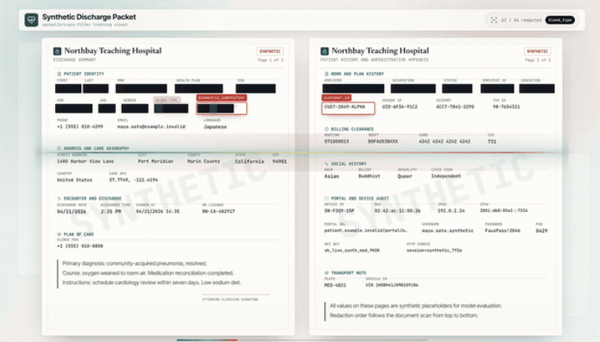
The 18 HIPAA identifiers include direct data points such as names, social security numbers, medical record numbers (MRNs), and contact information. They also cover indirect details like full dates, geographic subdivisions smaller than a state, and any unique characteristic that could reveal a patient's identity.
To achieve "de-identification" under the Safe Harbor rule, you must remove or replace these elements with bracketed labels. This process ensures the clinical text is no longer considered Protected Health Information (PHI) before it is processed by AI tools.
 Hazem Abbas
4- Safe Harbor Rule:
The Safe Harbor Rule provides a specific federal standard under 45 CFR § 164.514(b) for de-identifying clinical text. It requires the rigorous removal of all 18 HIPAA identifiers, including names, MRNs, and full dates.
Effectively stripping these details ensures that the remaining data is no longer considered Protected Health Information, allowing for safer processing within AI tools.
 Hazem Abbas
Step-by-Step: Securing Your AI Workflow
While standard ChatGPT (Free or Plus) does not offer a BAA and is therefore not HIPAA-compliant for PHI, you can still use it safely for administrative tasks by following these rigorous steps:
- Harden Your Privacy Settings: Log into ChatGPT, go to Settings, and turn off "Chat History & Training" to ensure your data isn't used to train future models.
- Enable Two-Factor Authentication (2FA): Under account settings, activate 2FA to prevent unauthorized access to your account.
- De-identify Manually Before Pasting: Never input real patient names, full dates, or contact info. Use bracketed labels like
[NAME]or[DATE]to replace sensitive details.
Use a De-identification Prompt: For an extra layer of security, use a specialized prompt to instruct the AI to act as a HIPAA-aware assistant.
Prompt Example: "De-identify the following clinical text in accordance with the HIPAA Safe Harbor Rule. Remove all 18 identifiers, including names, MRNs, and geographic info smaller than a state. Return only the de-identified version."
The "Honest Expert" Guardrail: Know the Limits
It is critical to remember that turning on privacy settings does not make ChatGPT HIPAA-compliant.
- The Legal Bottom Line: You are legally responsible for every piece of data you paste into the chat.
- Reliability: AI cannot be 100% relied upon to catch every piece of PHI; manual oversight is always required.
- Enterprise Solutions: For true HIPAA compliance where you handle raw patient data, you must use enterprise-grade solutions like Microsoft Azure OpenAI or Nuance DAX Copilot, which provide a BAA.
Safe and Sharp: The Path Forward
By moving your AI usage "upstream", using it to generate general templates rather than processing raw patient files, you can enjoy the benefits of AI documentation without the liability.
Always consult your organization’s legal or compliance team before making AI a permanent part of your clinical workflow. With the right safeguards in place, you can stay sharp, stay compliant, and focus on what matters most: your patients.