8 Open-Source Prompt Management Solutions: The Secret Weapon Every AI Developer Needs


If you're building AI apps, chatbots, or LLM-powered tools, there’s one thing most teams overlook, prompt management.
It’s not just about writing clever sentences. It’s about organizing, versioning, testing, and scaling your prompts like real code. And when done right? You unlock faster iteration, fewer hallucinations, better user experiences, and full team collaboration.
Let me tell you why this is no longer optional, it’s essential.
What Is Prompt Management?
Think of prompts as the "code" behind your AI interactions. Just like developers version control their Python scripts with Git, prompt managers treat prompts as first-class assets.
Prompt management isn’t just saving a few text snippets in a folder. It’s a system that tracks:
- Who wrote the prompt
- When it was changed
- How it performs across different models
- Whether it works under edge cases
You’re not just storing prompts, you’re orchestrating intelligence.
From customer service bots to creative copywriters, every successful AI product relies on well-managed prompts. And in 2025, if you’re still using plain text files or Notion pages, you’re falling behind.
 Hazem Abbas
 Hazem Abbas
Why Prompt Management Is More Important Than Ever
Here’s the hard truth: bad prompts = bad outputs (Results) even with GPT-4 or Claude 3.
Without proper management, you face:
- Prompt drift: Small changes over time create inconsistent results.
- No audit trail: Can’t trace who made a change or why?
- Team chaos: One dev writes a prompt, another edits it without context.
- Security risks: Sensitive prompts exposed in shared docs.
- Wasted time: Rebuilding what already exists.
But with prompt management, You get:
- Consistency across users
- Faster debugging
- Team-wide transparency
- Compliance-ready records
- Performance tracking over time
This isn’t just nice-to-have, it’s critical for scaling AI responsibly.
And let’s be real: if your company can’t track how its AI behaves, it can’t trust it. That’s where open-source tools shine.
 Hazem Abbas
How to Manage Prompts Like a Pro (Even If You’re Solo)
You don’t need a massive team to start managing prompts effectively. Here’s how to do it right, step by step:
Start with versioning. Use Git-like systems to track changes. Even a simple prompts/v1/ vs prompts/v2/ folder structure helps.
Tag each prompt with metadata:
use_case: customer_supportmodel: gpt-4-turbocreated_by: [email protected]last_updated: 2025-04-05
Use categories — group prompts by function (e.g., summarization, classification, role-playing). This makes searching easier later.
Add documentation. Write a short line explaining what this prompt does, and what kind of output you expect.
Finally, integrate testing workflows. Run sample inputs through multiple versions and compare results.
Yes, even solo devs benefit from this discipline. Think of it as “prompt hygiene.”
 Hazem Abbas
Prompt A/B Testing: Turn Guesswork Into Data
You wouldn’t launch a new landing page without testing two versions. So why do the same with prompts?
A/B testing lets you answer real questions:
“Does ‘Write a friendly email’ perform better than ‘Draft a professional message’?”
“Which version generates more accurate responses for legal summaries?”
 Hazem Abbas
Tools like LangSmith, PromptFlow, and custom setups allow you to:
- Run two prompt variants side-by-side
- Measure accuracy, speed, coherence, and user satisfaction
- Use statistical significance to validate results
For example: An e-commerce startup tested two product description prompts. One used emotional language (“perfect for weekend adventures”), the other factual (“lightweight, water-resistant, ideal for hiking”). Result? The emotional version increased click-through rates by 37%. That’s not luck, it’s data-driven optimization.
 Hazem Abbas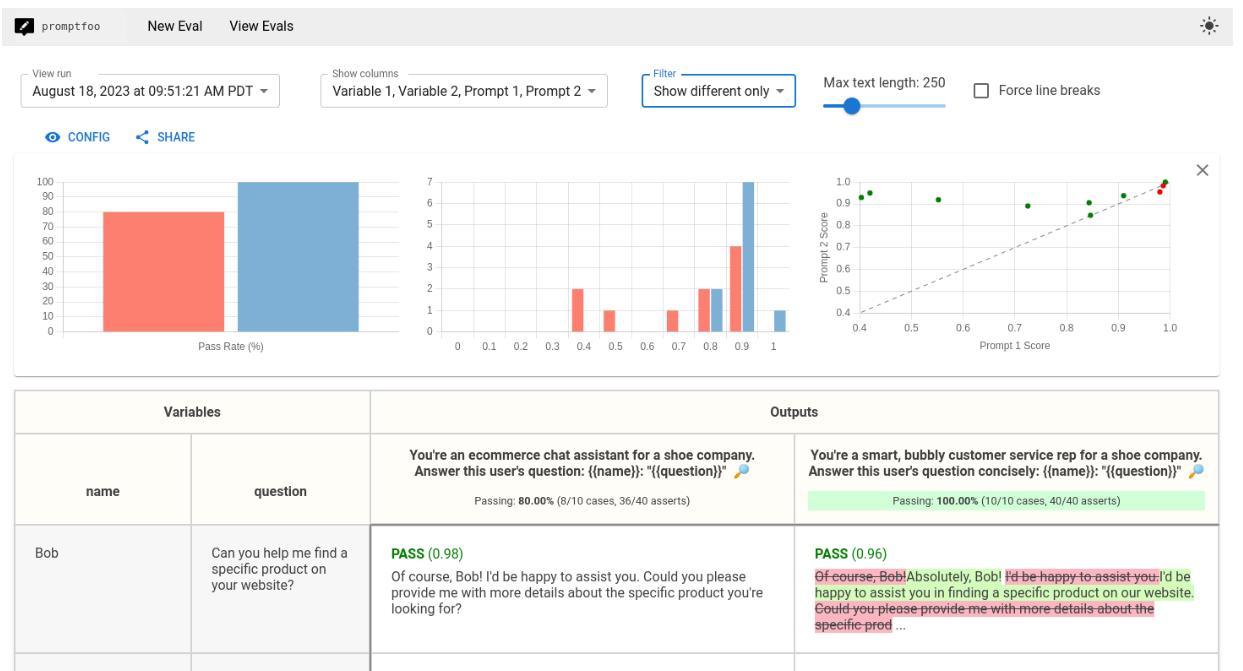
Top Open-Source Prompt Management Tools
Want to build a robust system without vendor lock-in? These open-source tools are game-changers:
1- PromptFlow (Microsoft)
Prompt flow is a suite of development tools designed to streamline the end-to-end development cycle of LLM-based AI applications, from ideation, prototyping, testing, evaluation to production deployment and monitoring. It makes prompt engineering much easier and enables you to build LLM apps with production quality.
 microsoft
2- LlamaIndex + PostgreSQL
This is a flexible, lightweight, works with any LLM. Perfect for developers who want full control. It is ideal for Custom-built apps with dynamic prompt logic.
 Fares
Fares
3- Dify (Open Core)
Dify is an open-source platform for developing LLM applications. Its intuitive interface combines agentic AI workflows, RAG pipelines, agent capabilities, model management, observability features, and more, allowing you to quickly move from prototype to production.
It is a full-stack platform with built-in prompt library, agent creation, and self-hosting.
 langgenius
4- PromptDB (GitHub-based)
PromptDB is a lightweight, open-source database designed to store, organize, and share prompts for AI models like GPT-3, DALL·E, MidJourney, and Stable Diffusion. Built with simple JSON storage, it offers fast setup, powerful search, and intuitive tagging, making it easy to manage your prompt library without complexity.
Perfect for solo developers, startups, and creators who want a no-frills, self-hosted solution to keep their prompts organized, reusable, and discoverable. No heavy infrastructure. Just pure prompt power.
5- PromptPal
PromptPal is a lightweight, open-source prompt management tool built for AI developers, startups, and solo creators who want to organize, track, and scale their prompts, fast and effortlessly.
Think of it as Git for your prompts, but simpler, smarter, and designed specifically for AI workflows. Whether you're using GPT, DALL·E, MidJourney, Stable Diffusion, or any LLM, PromptPal helps you store, version, search, and collaborate on prompts like a pro.
With just 12.3MB of memory, one-line Docker setup, and support for SQLite, PostgreSQL, and MySQL, it’s perfect for local testing or team deployment. Plus, SDKs for Node.js and Golang make integration a breeze.
PromptPal's features include:
- One-Line Setup: Launch in seconds with a single Docker command
- Flexible Deployment: Works seamlessly on-premise or in the cloud
- Multi-Database Support: SQLite (for local dev), PostgreSQL & MySQL (for teams & scale)
- SDKs for Golang & Node.js: Plug in easily into your existing AI apps
- Smart Prompt Tracking: Create, organize, and monitor all your prompts in one place
- Team Collaboration: Comment, clarify, and align with teammates in real time
- Coming Soon: Analytics – Track performance, spot trends, boost productivity
- Coming Soon: Version Control – Auto-backup, diff changes, and roll back safely
 PromptPal
6- Promptimizer
Promptimizer is a free and open-source app that uses AI-powered genetic algorithms to auto-optimize prompts for stock screening, evolving smarter, faster results. Built for accuracy & efficiency, it’s perfect for traders and devs.
It is not just a simple AI prompt manager as it helps you optimize your prompt for better outputs.
Promptimizer's features include:
- Genetic algorithm-based optimization of AI prompts
- Population management with crossover and mutation operations
- Training and validation using separate datasets
- Automated evaluation of prompt performance
- Multi-generational evolution of prompts
- Customizable parameters for population size, generations, and more
 austin-starks
7- Latitude
Latitude is an open-source platform for both AI agents and prompt engineering. It covers the entire lifecycle: from design and testing to deployment, observability, and scaling.
Key features include:
- Collaborative Design → version prompts and agents with your team
- Playground → test interactively with different inputs, parameters, and configurations
- Evaluations → choose from built-in evals, use LLM-as-judge, or add human-in-the-loop
- AI Gateway → deploy as API endpoints that stay up-to-date with published changes
- Logs & Observability → monitor costs, latency, and performance in real time
- Experiments → run controlled tests across models and providers
- Datasets → manage test data for batch evaluations and regression testing
- Integrations → connect with 2,500+ tools
 latitude-dev
8- E.D.D.I: Smart Middleware for AI Conversations
E.D.D.I (Enhanced Dialog Driven Interface) is a lightweight, cloud-native Java middleware built with Quarkus for seamless management of LLM-powered conversations.
It connects OpenAI, Anthropic, Google Gemini, Hugging Face, Ollama, and more, enabling advanced prompt handling, stateful dialog control, and scalable API orchestration. Fully Docker-certified by IBM/Red Hat, it’s ideal for enterprise-grade AI apps deployed via Kubernetes or OpenShift.
 labsai
💡 Pro tip: Combine tools. Use PromptFlow for orchestration, store your database in PostgreSQL, and add LangSmith for evaluation.
All these tools support self-hosting, so your prompts stay secure and private.
Build Your Own Self-Hosted Prompt Manager (Step-by-Step)
Want full ownership? Let’s build a basic but powerful prompt manager, free, customizable, and 100% yours.
Tech Stack:
- Backend: FastAPI (Python)
- Database: PostgreSQL or SQLite
- Frontend: React + Tailwind CSS
- Version control: Git (yes, really!)
Steps:
- Create a
promptstable with columns:id,name,content,version,tags,created_at,model_used - Add CRUD endpoints (create, read, update, delete)
- Implement search by tag or model
- Add version history (store old versions in a separate table)
- Integrate LLM scoring (e.g., use GPT-4 to rate prompt quality)
- Deploy via Docker + Nginx
Bonus: Add a GitHub template repo so others can fork it.
🔍 Keyword-rich: “How to build a self-hosted prompt manager”, “open-source prompt database tutorial”
This isn’t just a tool, it’s a foundation for future AI innovation.
Advanced Prompt Strategies You Should Know
Now that you’ve got basics down, level up with these pro techniques:
🔹 Prompt Templating (Jinja2/Handlebars)
Instead of hardcoding values, use templates:
Hello {{user_name}}, your order #{{order_id}} is confirmed!
Dynamic, reusable, scalable.
🔹 Dynamic Prompt Injection
Inject context based on real-time input — like user location, past behavior, or session state.
🔹 Prompt Chaining
Break complex tasks into steps:
- Summarize article
- Extract key points
- Generate tweet
- Suggest hashtags
Each step uses a refined prompt, smarter, more accurate.
🔹 Bias Detection
Run your prompt through a bias scanner. Ask: Does this prompt favor certain demographics?
🔹 Prompt Caching
Cache common prompt outputs to reduce latency and API costs.
These aren’t fancy tricks — they’re best practices used by top AI teams.
The Future of Prompt Management: What’s Next?
We’re just scratching the surface.
In the next 2–3 years, we’ll see:
- AI agents that auto-generate and optimize prompts
- Prompt marketplaces (like npm for prompts)
- Blockchain-backed provenance to verify prompt origins
- MLOps integration — prompts as part of CI/CD pipelines
- Ethical governance frameworks to prevent misuse
Prompt management isn’t just about tools — it’s about responsibility, transparency, and evolution.
The companies that master it now will lead the next wave of AI adoption.
FAQs (Rich Snippets Ready!)
Q: Can I use open-source prompt management with GPT-4?
A: Yes! Most tools are LLM-agnostic. You can plug in GPT-4, Claude, Llama, or any model.
Q: Is prompt management only for large teams?
A: No. Solo developers, freelancers, and startups benefit from organization and versioning.
Q: How do I secure my prompts?
A: Use self-hosted tools with encryption, access controls, and audit logs. Never store sensitive prompts in public repos.
Q: What’s the difference between prompt storage and prompt management?
A: Storage is just saving files. Management includes versioning, testing, tagging, evaluation, and collaboration.
Free Resources & Community Links
Level up your skills with these free tools:
Subscribe to newsletters like The Batch, AI Weekly, and Prompt Engineering Digest for weekly insights.
Final Thought: Stop Writing Prompts. Start Managing Them.
Prompts are no longer just strings of text. They’re core components of AI systems, and they deserve the same care as code, databases, or APIs.
With open-source tools, self-hosting options, and smart strategies, you can build a scalable, auditable, high-performing AI workflow, today.
So whether you’re a developer, product lead, or AI enthusiast: start managing your prompts before your AI starts failing.
Because in 2025, the winners aren’t just using AI, they’re engineering it with precision.
Looking for more fancy open-source and self-hosted AI solutions?
Checkout our Archive!
 Hazem Abbas
 Hazem Abbas
 Hazem Abbas
 Hazem Abbas
 Hazem Abbas
 Hazem Abbas
 Hazem Abbas
 Hazem Abbas