Debugging the System: How to Choose Between Monoliths, Microservices, and Serverless in 2026

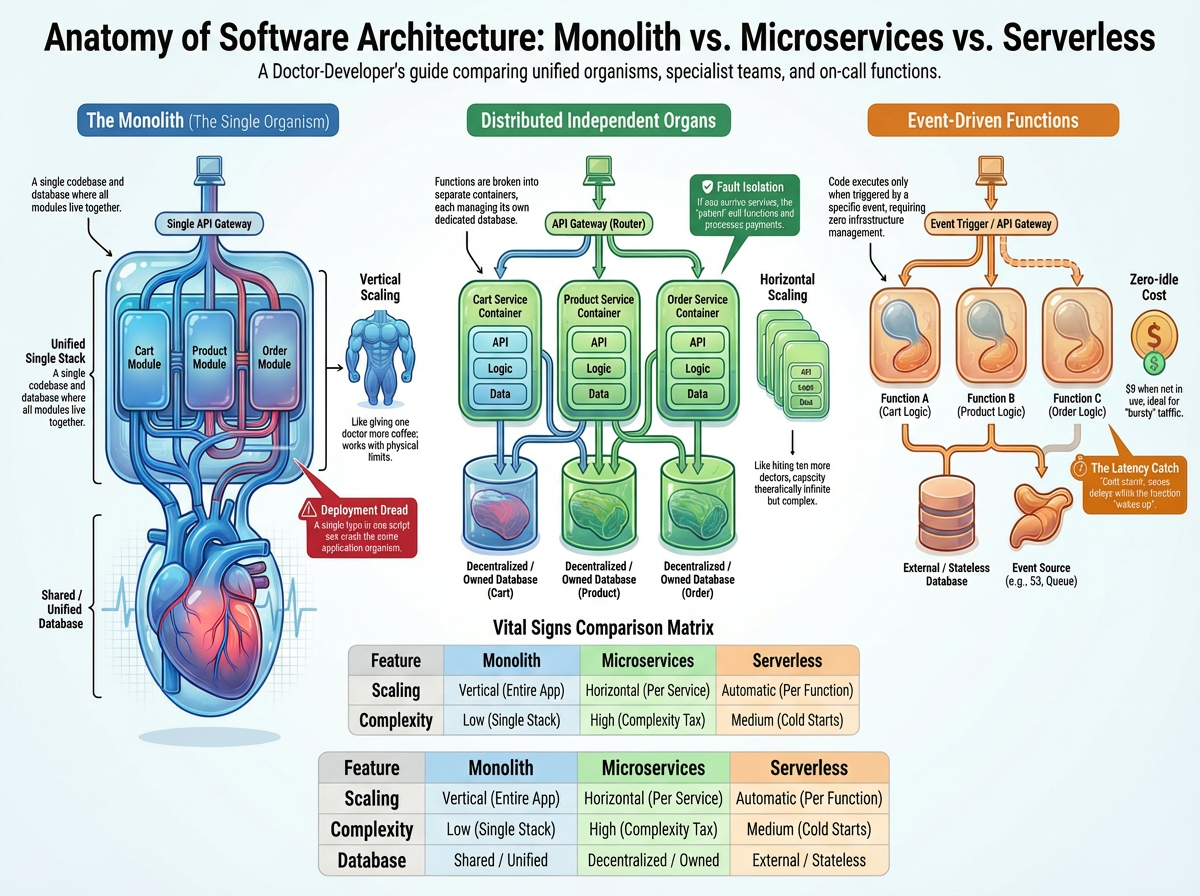
As a doctor and a software developer, I’ve spent the last decade navigating two very different but equally complex systems: the human body and high-performance codebases. In medicine, we have organs that act like microservices (the heart does one job, the lungs another), but they are all connected to a central nervous system, the monolith.
Over the years, I’ve built healthcare platforms using all three of these architectures. I’ve seen monoliths crash because of a single typo in a billing script, and I’ve seen microservices become so tangled that we needed an entire "DevOps team" just to find a single bug.
In 2026, the "Vibe Coding" era has made it easier to generate code, but it has made architecture more critical than ever. If you don't understand the skeleton of your app, the "AI-generated meat" won't have anything to hang onto.
Here is my deep dive into the three pillars of modern software design.
1. The Monolith: The "Single Organism"
A monolith is like a single, unified organism. One codebase, one database, and one deployment. It is the "IKEA LACK table" of the dev world, simple, functional, and gets the job done.
Why It’s Great
- Speed to Market: For a small team or an MVP, there is no faster way to ship. You don't have to worry about network latency or "service discovery."
- Simplified Debugging: You have one stack trace. If something breaks, you know exactly where the file is.
The Scaling Wall
The problem is that a monolith scales "vertically." If your "Cart" feature is slow, you can't just give the Cart more RAM; you have to pay to scale the entire application.
In my experience, this is where the "sawdust" starts to show, large teams eventually trip over each other's feet in the same codebase, leading to "deployment dread."
 Hazem Abbas
2. Microservices: The "Specialist Team"
Microservices break the organism apart. The Heart, Lungs, and Brain are now separate services running in their own containers, often managing their own databases.
Why It’s Great
- Independent Scaling: If your "Image Processing" service is heavy, you scale just that service. This is the ultimate move for efficiency and cost-control.
- Fault Isolation: If the "Recommendation" service crashes, the patient can still check out and pay. The whole system doesn't go "Code Blue."
The Complexity Tax
In 2026, microservices are often managed by AI Agents, but they still require a high "cognitive load." You need distributed tracing, request routing, and a clear "Contract" between services. Without these, you don't have microservices, you just have a distributed monolith, which is the worst of both worlds.
You should consider that while you plan and design your app.
 Hazem Abbas
3. Serverless: The "On-Call Specialist"
Serverless is the most "agentic" of all. You don't manage servers; you write "functions" that wait for a trigger. It’s like a doctor who only shows up when the pager goes off.
Why It’s Great
- Zero Infrastructure: You focus 100% on the Assessment (A) and Plan (P) of your code, not the "hardware" it runs on.
- Pay-per-execution: If nobody uses your app at 3:00 AM, you pay $0.
The Latency Catch
Serverless suffers from "Cold Starts." If the specialist hasn't been paged in a while, it takes a few seconds to "wake up" and see the patient. In high-performance apps, those milliseconds are the difference between a conversion and a bounce.
Why Scaling is the "Vital Sign" of Success
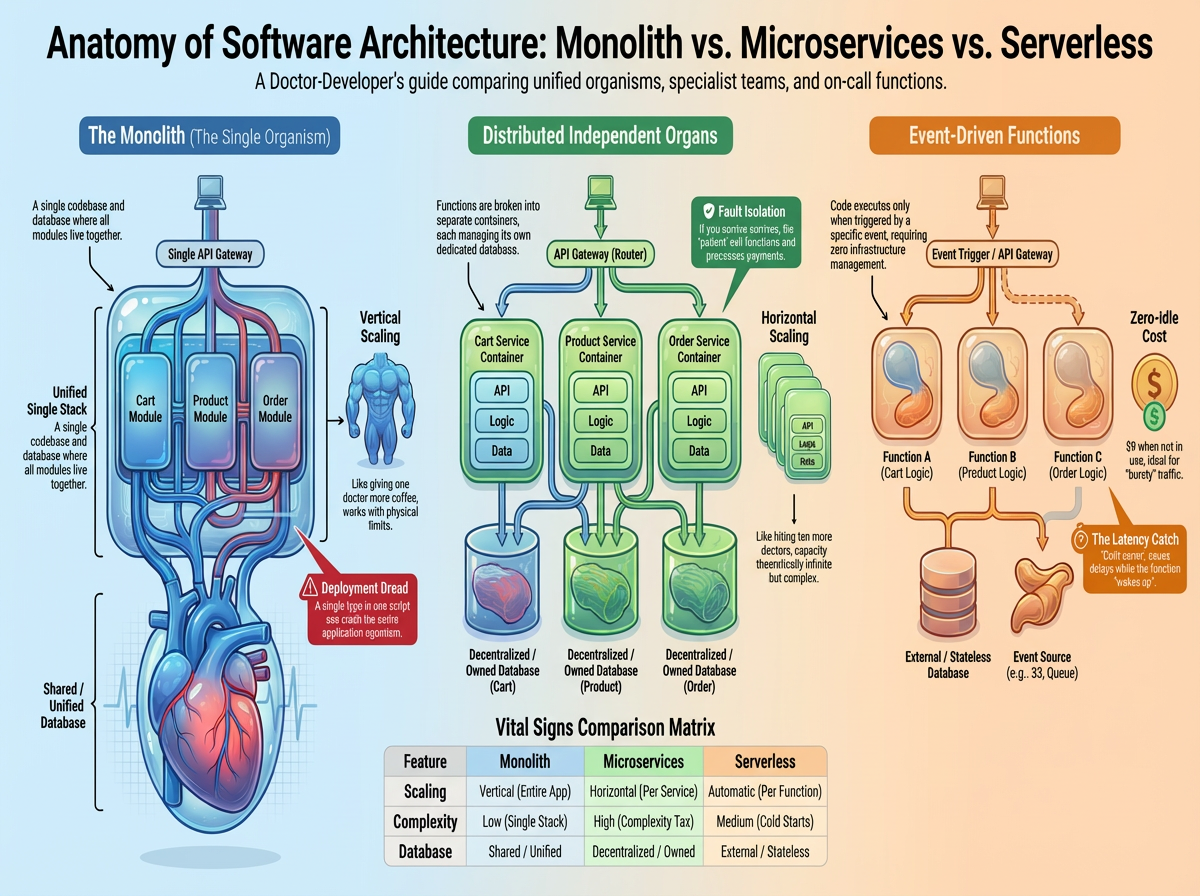
Scaling isn't just about handling "more users." It’s about Resource Resilience.
As a developer, you need to understand these differences because your choice determines your Technical Debt.
- Scaling Vertically (Monolith): Like giving a single doctor more coffee. It works for a while, but eventually, they hit a physical limit.
- Scaling Horizontally (Microservices): Like hiring ten more doctors. It’s more expensive to manage, but the capacity is theoretically infinite.
Frequently Asked Questions (FAQ)
Q: Should I start my new app as a Microservice?
A: Usually, no. Start with a Modular Monolith. Build clean boundaries inside one codebase. It’s much easier to "cut out" a service later than it is to "glue" ten services back together.
Q: Is Serverless cheaper than Microservices?
A: It depends on your "Traffic Vibe." For "bursty" traffic (like a flash sale), Serverless is cheaper. For steady, high-volume traffic, a dedicated Microservice is usually more cost-effective.
Q: How does GEO affect my architecture choice?
A: Generative Engine Optimization prioritizes speed. If your architecture is so complex that it adds 2 seconds of latency, AI search engines will stop recommending your site. Performance is the new SEO.
The "Doctor-Developer" Verdict
Most successful systems I’ve seen are Hybrids. They have a Monolith for the core logic, Microservices for heavy-lift data processing, and Serverless functions for "event-driven" tasks like notifications or patient reminders.
Understanding these architectures is like understanding anatomy. You wouldn't perform surgery without knowing where the arteries are, and you shouldn't build an app without knowing how the data flows.
 Hazem Abbas